


June 18, 2026
Ali Hemani never pointed his gun at anyone. He never threatened anyone with it. When federal agents arrived at his home in a Dallas suburb in 2022, he handed it over voluntarily, pointed out the marijuana sitting on the property, and sat down for a cooperative interview. He told the agents he smokes marijuana about every other day. He went back to his job and his family and waited.
More than six months later, the government charged him with a federal felony.
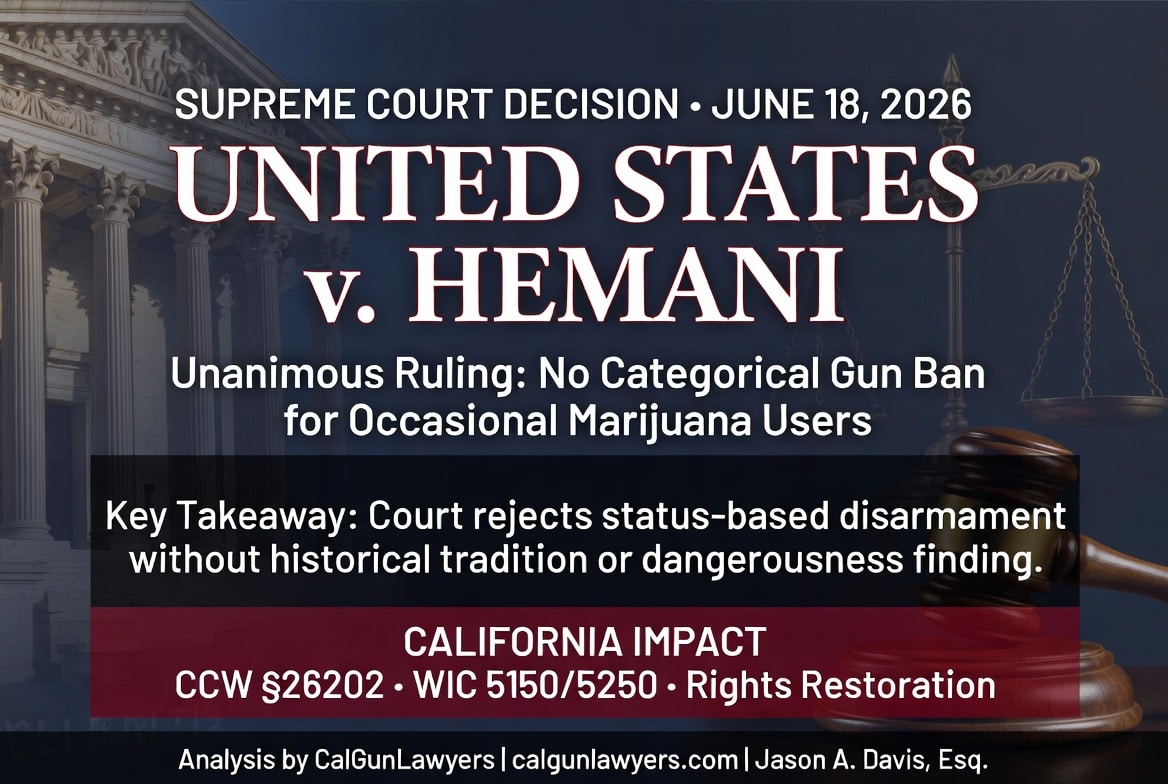
On Thursday, the Supreme Court unanimously said it couldn’t do that. The ruling in United States v. Hemani is the Court’s most significant Second Amendment opinion since New York State Rifle & Pistol Association v. Bruen in 2022. It does not resolve every question it raises — the opinion is deliberately narrow — but it reinforces and extends the Bruen framework in ways that will bear directly on a range of pending cases, including California’s concealed carry disqualification statute and a cluster of mental health-based firearms prohibitions that have been working their way through the lower courts.
The full opinion is available on the Supreme Court’s website at supremecourt.gov.
Ali Hemani is a dual U.S.-Pakistan citizen who was born in Texas and has spent most of his life in the Dallas area, working a stable job and living with his family. Federal agents, suspecting Hemani and his family of terrorism-related activities, obtained a warrant and searched the family home in 2022.
They found no evidence of terrorism. What they did find was a pistol and approximately 60 grams of marijuana. Hemani was cooperative throughout — he surrendered the weapon, acknowledged the drugs, and in a subsequent interview told agents he used marijuana roughly every other day. He was never accused of brandishing the weapon, threatening anyone, or using it in any unlawful way. He simply owned a gun and used marijuana.
That was enough for a federal prosecution.
The government charged Hemani under 18 U.S.C. §922(g)(3), a federal law making it a felony for any person “who is an unlawful user of or addicted to any controlled substance” to possess a firearm. Marijuana remains a Schedule I controlled substance under federal law, meaning that any marijuana user — regardless of state law, regardless of how much they use, regardless of whether they are dangerous in any way — is technically a prohibited person under federal firearms law.
Hemani moved to dismiss the indictment on Second Amendment grounds. The district court agreed with him. The government appealed. The Fifth Circuit reversed. The Supreme Court granted certiorari, and on Thursday, in a unanimous opinion authored by Justice Neil Gorsuch, the Court sided with Hemani.
The decision turns entirely on the framework established in Bruen. Under that framework, a firearms regulation is constitutional only if it is consistent with the nation’s historical tradition of firearm regulation. The government cannot simply assert an interest in public safety. It must identify historical analogues — laws from the founding era or the Reconstruction period that imposed comparable burdens on comparable categories of people for comparable reasons.
The government tried. It pointed to historical laws disarming people deemed dangerous, laws targeting those who threatened public order, and laws conditioning the right to bear arms on loyalty and good behavior. The Court found none of them sufficient to support a categorical, permanent prohibition on gun ownership for occasional drug users.
The key word is categorical. Hemani was not found dangerous. He was not intoxicated when agents arrived. He had not misused his weapon. He was simply a person who, on some days, used marijuana — and the government sought to permanently strip him of a constitutional right on that basis alone.
“The historical evidence the government presents does not support the categorical restriction it urges,” Justice Gorsuch wrote for the Court.
The opinion is careful to limit its reach. It does not hold that drug users can never be disarmed. It explicitly preserves the possibility that Congress could enact laws targeting addicts, people who are actively intoxicated, or users of drugs that a legislature specifically finds pose special dangers. What it forecloses is the blunt instrument of §922(g)(3) as applied to casual, non-dangerous users like Hemani.
The law at issue in Hemani is the same law under which Hunter Biden was convicted in 2024. Biden was found guilty of purchasing a firearm in 2018 while allegedly addicted to crack cocaine — a factually different scenario than Hemani’s casual marijuana use, but prosecuted under the identical statute.
The Court’s narrow holding leaves Biden’s situation in genuine legal uncertainty. The majority opinion distinguishes between casual users and addicts, suggesting that addiction — involving a more sustained and consuming relationship with a substance — might present a stronger historical case for disarmament. But it declines to decide that question, leaving it for future cases.
What is clear is that the legal landscape for prosecutions like Biden’s has shifted. Any future prosecution under §922(g)(3) will now face a demanding historical inquiry, and the government’s track record in that inquiry, post-Bruen, has not been strong.
Hemani did not address concealed carry permitting directly, but its reasoning bears closely on a specific structural problem in California’s CCW framework that has been generating litigation since Bruen forced the state to move from a discretionary “may issue” system to a nominally “shall issue” one.
California Penal Code §26202 defines who qualifies as a “disqualified person” ineligible to receive a CCW license. The statute includes several categorical disqualifications — for prior offenses, for mental health adjudications, for conduct indicating danger to self or others — without uniform lookback periods. Some of those categories operate as effectively permanent bars, with no time limit and no mechanism for an applicant to demonstrate that the disqualifying circumstance is no longer relevant. Others have defined windows (ten years for certain prior charges) but sweep in dismissals and charges that were never adjudicated on the merits.
The Bruen problem with this structure is the same one Hemani identifies in §922(g)(3): categorical disarmament without individualized dangerousness assessment, and without a clear historical tradition supporting the specific scope of the restriction. An applicant denied a CCW license under §26202 based on a decade-old incident — particularly one that was dismissed, resolved without a conviction, or reflects a circumstance that has long since passed — faces a permanent barrier with no meaningful path to demonstrate current fitness. The statute does provide a hearing process under §26206, but that hearing places the burden on the government only after denial, and the disqualification criteria themselves remain constitutionally untethered to historical analogues.
Hemani does not resolve these cases, but it strengthens the argument that disqualification criteria without defined lookback periods, without individualized dangerousness findings, and without historical grounding are constitutionally suspect — particularly for the carry right that Bruen confirmed extends outside the home.
The most constitutionally complex implications of Hemani may lie in mental health-based gun restrictions, where the Court’s logic runs directly into frameworks that were never designed with Second Amendment scrutiny in mind.
California Welfare & Institutions Code §5150 authorizes law enforcement or certain mental health professionals to involuntarily detain a person for up to 72 hours when there is probable cause to believe they may be a danger to themselves or others, or gravely disabled. The hold is explicitly an observation and evaluation mechanism — its purpose is to allow an accredited mental health facility to assess whether the person is actually dangerous and, if so, to begin initial treatment. No court is involved, no adversarial process occurs, and no findings of fact are made by a neutral decision-maker. A 5150 is the first step in a process designed to determine dangerousness, not a conclusion that dangerousness has been established.
Under WIC §8103(f)(1), however, a 5150 hold triggers an automatic five-year firearms prohibition upon release — regardless of what the evaluation finds. The prohibition attaches at intake, before the evaluation has occurred, and it remains in place even if the facility concludes the person poses no actual danger. A person detained for observation, evaluated, found not to be a genuine threat, and released, nonetheless loses their Second Amendment rights for five years.
If the hold escalates — if a treating facility seeks to extend detention beyond 72 hours and a superior court certifies the person for intensive treatment under §5250 — the state prohibition remains five years. But here the federal layer kicks in: a §5250 certification constitutes an “involuntary commitment to a mental institution” under 18 U.S.C. §922(g)(4), triggering a federal lifetime prohibition that survives even if California’s five-year ban is successfully challenged or expires.
The 5150 prohibition is perhaps the most direct target of Hemani’s reasoning. The government in Hemani could not point to a historical tradition of disarming people based on status alone, without a finding of actual dangerousness. A 5150 hold is exactly that: a status event with no finding. A clinician detains someone for observation; that detention alone — regardless of outcome — permanently alters the person’s constitutional rights for five years at the state level and potentially for life at the federal level if escalated.
The historical record does not support this. Emergency detention mechanisms existed at the founding, but they were not generally understood to carry automatic, long-term disarmament consequences independent of any judicial finding. The link between a 72-hour psychiatric observation and a five-year gun ban, attached automatically and without any neutral adjudication of dangerousness, lacks the historical grounding Bruen and Hemani require.
The 5250 situation is more complicated, because it does involve a court — a superior court must certify the 14-day hold — but that certification turns on whether intensive treatment is warranted, not on whether the person poses a specific danger of gun misuse. A court finding that someone needs two weeks of inpatient psychiatric care is not the same as a finding that they cannot safely possess a firearm. Under Hemani’s logic, that gap matters.
Roe 1 v. United States is currently active in federal court and directly challenges California and federal policies barring Second Amendment rights for people with prior mental health restrictions. The case targets exactly the intersection of WIC 8103, §922(g)(4), and the absence of any individualized dangerousness finding — the same structural problem Hemani now reinforces from the top down.
Even where the initial disarmament might survive historical scrutiny, the permanent and unreviewable character of federal prohibition under §922(g)(4) is independently vulnerable. Historical disarmament mechanisms were rarely irrevocable — they were conditional, tied to ongoing status, or subject to review. A lifetime federal ban attaching to a single psychiatric hospitalization, with no functional restoration process, does not map cleanly onto that tradition. The NICS Improvement Act created a theoretical relief mechanism, but it remains largely nonfunctional: most states do not have an approved restoration program, and the federal program has operated inconsistently for years.
Taken together, Hemani and the cases it will inform suggest a Second Amendment jurisprudence moving in a consistent direction: away from categorical, status-based restrictions and toward individualized, historically grounded, and reviewable determinations of dangerousness.
That is a more demanding standard for gun regulation in specific, structural ways — it requires legislatures to identify historical analogues rather than invoking public safety interest-balancing. But the Court in Hemani was unanimous, and the opinion takes care to preserve substantial regulatory space. Restrictions on the actively intoxicated, on genuine addicts, on people found specifically and individually dangerous — all remain available under the Court’s framework.
What the framework places under pressure is regulatory bluntness: broad categorical prohibitions imposed on large classes of people without serious engagement with either historical tradition or individual dangerousness. That description fits meaningful portions of both federal mental health gun law and California’s CCW disqualification framework.
Ali Hemani surrendered his gun voluntarily, answered every question honestly, and went home. The Court said the government had no business making that a felony. The lower courts will be working out the downstream consequences of that holding for some time.
Subscribe to get the latest posts sent to your email.