


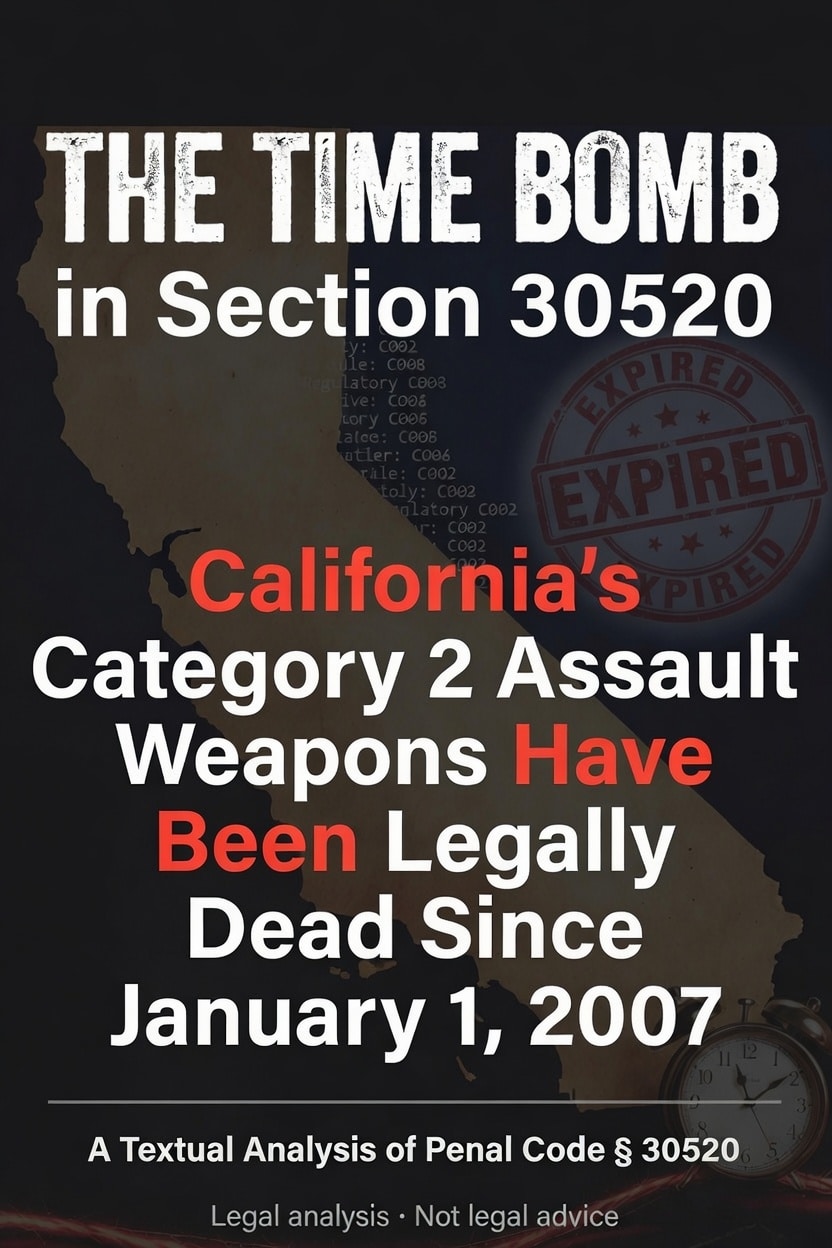
California’s Department of Justice sorts the state’s banned assault weapons into three categories. Category 1 is the original Roberti-Roos roster — the rifles, pistols, and shotguns named by make and model in the statute itself, now Penal Code section 30510, subdivisions (a) through (c). Category 3 is the familiar “SB 23” definition — weapons identified by generic characteristics such as pistol grips, flash suppressors, and detachable magazines, now section 30515. Between them sits Category 2: the AK and AR-15 “series” weapons, roughly sixty additional makes and models that appear nowhere in any statute, but only on a list the Attorney General published in the year 2000, printed today in title 11, section 5499 of the California Code of Regulations.
This article makes a single claim about Category 2, and the claim is textual: its legal foundation expired on January 1, 2007, by the express terms of the statute that created it, and the savings clause the Legislature wrote to preserve the list does not — by its own words — cover a single firearm on it. The Legislature armed the device in September 2006. It detonated four months later. It has been sitting undiscovered in the California Code of Regulations for nearly two decades, and the Attorney General has published the list ever since without any statutory authority to do so.
To see the time bomb, you have to read three generations of one statute, a Supreme Court decision that made the list the sole source of Category 2 status, the Department of Justice’s own internal correspondence from the spring of 2006, and a two-word drafting error that cut the parachute loose from the only cargo it was packed to save. This article walks through all of it, with the complete statutory texts, because the argument lives in the exact words.
The Roberti-Roos Assault Weapons Control Act of 1989 built a scheme with a deliberate division of labor. The Legislature designated assault weapons by naming them in former Penal Code section 12276 — the enumerated models, plus the “series” concept sweeping in minor variations of the named AK and AR-15 rifles. The courts declared additional weapons to be assault weapons through a judicial add-on procedure in former section 12276.5: the Attorney General petitioned a superior court, the court held a hearing, and if the Attorney General carried the burden of proof, the court issued a declaration that the weapon was an assault weapon. The Attorney General himself designated nothing and declared nothing. His role was scrivener: he promulgated a list transcribing both categories — the designated and the declared — and filed it with the Secretary of State for publication in the California Code of Regulations.
This vocabulary — designate, declare, promulgate, three different acts by three different actors — is not stylistic. It is the load-bearing structure of everything that follows, and the statute enforced it with precision. Former section 12276, subdivision (d), defined the add-on category this way:
Declared by the court. Promulgated by the Attorney General. Two acts, two actors, and both required.
Here is the relevant text of former section 12276.5 as it stood from the 1991 amendments (Stats. 1991, ch. 954) until 2006 — the version in force for the entire life of the events this article describes. Read subdivision (f) for who declares, and subdivision (h) for who promulgates:
12276.5. (a) Upon request by the Attorney General filed in a verified petition in a superior court of a county with a population of more than 1,000,000, the superior court shall issue a declaration of temporary suspension of the manufacture, sale, distribution, transportation, or importation into the state, or the giving or lending of a firearm alleged to be an assault weapon within the meaning of Section 12276 because the firearm is either of the following:
Chapter 3.5 (commencing with Section 11340) of Division 3 of Title 2 of the Government Code, pertaining to the adoption of rules and regulations, shall not apply to any list of assault weapons promulgated pursuant to this section.
Note the three features of subdivision (h), because everything turns on them. First, the promulgation duty is perpetual — no time limit, no condition, no expiration. Second, it is the only provision anywhere in the chapter that gives the list legal existence; nothing else enacts, incorporates, or independently sustains it. Third, the list it commands has exactly two kinds of content: firearms “designated as assault weapons in Section 12276” and firearms “declared to be assault weapons pursuant to this section.” Designated or declared. Keep that disjunction in mind. It will decide the whole question.
The add-on machinery barely functioned before it was frozen in litigation. A constitutional challenge — attacking the series provisions and the add-on procedure as unconstitutional delegations and denials of equal protection — kept the scheme substantially tied up through the 1990s. In Kasler v. Lockyer (2000) 23 Cal.4th 472, the California Supreme Court upheld it, and the path cleared.
Attorney General Bill Lockyer then did the thing that created Category 2: in August 2000, he promulgated the AK and AR-15 series list, adding roughly five dozen makes and models — Bushmaster, DPMS, Rock River Arms, Mitchell Arms, and the rest — to the roster in the California Code of Regulations (then title 11, section 979.11; renumbered without regulatory effect to section 5499 in June 2006). A registration window opened for existing owners. Critically for what follows, no court declared any of these weapons anything. The Attorney General identified them as “series” variants of the AK and Colt AR-15 rifles designated in section 12276, subdivisions (a)(1) and (a)(5), and listed them under subdivision (h)’s promulgation mandate — the “designated” prong of the disjunction. The judicial declaration procedure, enjoined for a decade and cumbersome by design, was never the source of a single entry.
Then came the decision that welded Category 2 to the list. In Harrott v. County of Kings (2001) 25 Cal.4th 1138, a gun owner sought return of an AR-15-type rifle that appeared on no list but that the county insisted was an AR-15 “series” weapon. The Supreme Court held that a firearm is an AK or AR-15 series assault weapon only if the Attorney General has listed it by make and model in the promulgated list. Trial courts may not decide, case by case, that an unlisted rifle is a series weapon. The court’s rationale was fair notice: ordinary citizens cannot be expected to determine, at their criminal peril, whether their rifle is a “variation, with minor differences” of a Colt AR-15; the promulgated list is what tells the public — and the courts — which weapons the series designation actually reaches.
Harrott completed a chain of total dependency. A Category 2 weapon’s status runs: statutory series designation (former § 12276(e)) à enforceable only through the promulgated list (Harrott) à which exists only as the continuing exercise of the subdivision (h) mandate. One foundation, all the way down. Sever the mandate and everything above it falls.
The federal assault weapons ban expired on September 13, 2004, and the industry answered immediately. AR-15 and AK-pattern rifles and receivers poured into the national market under new manufacturers’ names and new model designations — precisely the “variations, with minor differences” California’s series designation was aimed at, and, after Harrott, precisely the weapons that designation could not touch until the Attorney General listed them by make and model.
California buyers understood the Harrott gap with complete clarity, and they exploited it at the component level. A stripped lower receiver bearing an unlisted maker’s name was not a series weapon (it was not listed), and it was not a characteristics weapon (a bare receiver has no pistol grip and no flash suppressor — indeed, no ability to fire). The question was put to the Department of Justice directly, and the Department gave the only answer the law allowed. As Attorney General Bill Lockyer would later recount to the Governor, his office “determined that such a ‘lower receiver’ is legal to possess in California,” because clone receivers “are not ‘series weapons’ under section 12276 (since the Attorney General has not listed them pursuant to section 12276.5)” and “do not contain any of the characteristics that would make them assault weapons.” The letter acknowledged what everyone in the fight already knew: the receivers were “primarily designed so that they can be made into Colt AR-15 clones,” and “[k]its are readily purchased and instructions are available on the Internet so that anyone can transform their legal-to-own receiver into an illegal assault weapon.” Though the Attorney General and the Department of Justice would discuss this internally, they did their best to conceal this information from the general public; it would only come to light publicly through Freedom of Information Act requests later.
The Department’s first instinct was the institutional one: relist. Expand the roster to capture the new makes and models, as it had in 2000. Its internal account — a June 2006 background memorandum prepared for legislative staff — records both the discovery and the practice it interrupted. Since Harrott, the memo explains, “it has been the Department’s policy to update [the] list when the Department has direct knowledge — from monitoring of gun shows, licensed firearms dealer inspections and criminal enforcement actions — of ‘series’ weapons in commerce in the state.” Then: “In late 2005, the Department became aware of a number of models of lower receivers … in commerce in the state that were virtually identical to ‘series’ receivers, but not yet identified as such by the Department. Pursuant to the Harrott decision, those receivers were legal to buy and possess in California.” And the memo describes the response from those supporting the Constitutional right to Due Process and the Second Amendment, in terms that I will treasure permanently: “A fringe group of gun advocates is trying to pressure the Department into updating the ‘series’ list immediately. Their goal is to register and build as many full-blown assault weapons as possible.”
That was — minus the adjectives — exactly the strategy. Recalling my conversations, I was engaged against the Department over the threatened relisting, and my message to Deputy Attorney General Alison Merrilees was not a protest — it was a welcome. Go ahead and list, I told her: every listing opens a registration period under section 12285, and every registration period converts unlisted receivers into lawfully registered assault weapons, which their owners may then legally build out with every feature section 12276.1 prohibits. The list was no longer a weapon against the clones. It was the clones’ pathway to legality. Merrilees’ response was that the Department had no choice in the matter: the statute said the Attorney General “shall promulgate,” and in her view that duty compelled the Department to keep adding AR-15 and AK-47 variants to the list as they appeared. Read her position against subdivision (h), and she was not wrong — the mandate was mandatory, continuing, and perpetual, exactly as written. My answer was that a statutory duty is not a law of nature. If the duty compels the Department to keep manufacturing lawful assault weapons, remove the duty. Revise the statute. And out of that exchange came the basis of the provision that went into AB 2728: a terminal date on the promulgation mandate itself.
The Department’s internal correspondence from the spring of 2006 — obtained through a Public Records Act request I served on June 27, 2006, while the bill was pending — documents its side of that reckoning, and it is remarkable reading. By May 9, 2006, Merrilees was writing to Brian Siebel of the Brady Center to Prevent Gun Violence that the Department had painted itself into a corner on every wall of the room. On receivers: “Our office has concluded that we may not have the authority to list bare receivers,” because Penal Code section 12001’s receiver-equals-firearm rule did not extend to the assault weapons statutes, and “the Roberti-Roos list includes only assembled AW’s, not receivers.” On assembled weapons — and read this one twice — “we believe that SB 23 supercedes our ability to list fully assembled assault weapons,” because a new listing “would have to open a registration period, which seems to conflict with SB 23’s provisions and its intent.” On the future: “there is the ongoing problem of new models with slightly different names. We will never win that name game.” And in summation: “The Harrott decision really put us in a bind, as the dissent in that case predicted it would. As a result, the best approach seems to be to consider the add-on provisions to be outdated and superceded by SB 23.” The middle admission is a time bomb of its own: the Department’s counsel concluding, in writing and in the present tense, that the listing power over assembled assault weapons had already been superseded by SB 23. Category 2’s custodian doubted the vitality of the listing power years before the Legislature terminated it.
Three days later, on May 12, 2006, Merrilees circulated the Department’s draft “Amendments to the AW Statutes” — “our draft of the AW clean-up bill,” her transmittal called it, conceding, “Okay, we went a tad beyond clean-up.” The draft is the embryo of AB 2728, and its treatment of the promulgation mandate deserves exact reproduction, strikeouts and all. The Department proposed: “Until December 31, 2006, the Attorney General shall may promulgate a list that specifies all firearms designated as assault weapons in Section 12276 or declared to be assault weapons pursuant to this section” — followed, already in this first draft, by the savings sentence: “Any firearm declared to be an assault weapon prior to December 31, 2006, shall remain on the list filed with the Secretary of State.” Study what the Department’s own drafters did to the mandate. They struck “shall” and wrote “may” — dissolving the duty Merrilees had felt bound by into mere discretion — and then bolted an expiration date onto the discretion for good measure. The Legislature would ultimately restore “shall” and move the date one day, to January 1, 2007, but the architecture never changed from first draft to chaptered bill: a terminal date on the promulgation power itself, paired with a savings clause written — from the very beginning — in the word “declared.”
Then, on May 15, 2006, Merrilees sent the email this article will keep returning to. Answering Siebel, she surveyed the wreckage: “Although I am tempted to do something that would take the whole ‘series’ thing back to the courts (because the Harrott decision was so bad), I think it’s too late. The cat is out of the bag. We cannot buy back all of the series clones. We do not want to allow registration, so I think we’re stuck with SB 23 being the vehicle to regulate them.” And then, of the crown jewel itself: “As for the Kasler list that was promulgated pursuant to 12276.5, we think it will remain in place … We think the amendments would remove the ability to add on in the future, but keep the Kasler list in place so that the named weapons are illegal to own if not registered.” We think. Twice in two sentences. The continued existence of Category 2 — some sixty makes and models with felony liability attached — rested, by the drafter’s own contemporaneous account, on the drafting staff’s hedged prediction about their own handiwork.
What makes the exchange astonishing is that Siebel — the Brady Center’s lawyer — had flagged the structural danger hours earlier, in the very email Merrilees was answering: “If you repeal 12276.5, it would not enable DOJ to add other guns (and other receivers) to the list, however. It would be interesting to see what would happen if 12276.5 were repealed and you tried to apply the ‘series’ language of 12276(e) to AK and AR ‘series’ guns in light of Kasler’s language that all citizens have to do is consult the AG’s list…. Perhaps the courts would be forced to decide what ‘series’ guns really are.” Strip the optimism from his final sentence and what remains is this article’s thesis, stated by gun control’s own counsel in May of 2006: deconstruct section 12276.5, however, and the enforceability of the series designation goes up for grabs.
The bill that carried the package was a rush job, and the Department said so internally. AB 2728 was a gut-and-amend — Assemblyman Klehs’s pending bill hollowed out and refilled with the Department’s language — and DOJ legislative advocate Aaron Maguire apologized for it in a June 2, 2006 email to Senate staff: “sorry about the gut-and-amend, but our office had not contemplated taking any legislative action on this issue until very recently. We think this issue is important enough, however, to try to pass this legislation before Lockyer leaves office.” Read that last clause against the date in the enacted bill. The promulgation mandate expired on January 1, 2007 — the day Bill Lockyer’s term as Attorney General ended. The expiration date on Category 2’s foundation was set to the sponsor’s own clock.
One more fight shaped the final text. The Department’s draft package had also proposed treating the frame or receiver of a listed weapon as itself an assault weapon. I met with the Department in June 2006, where — as my follow-up correspondence memorialized — “the Department stated that a frame or receiver is not an ‘assault weapon’ under California law.” My June 26 and 27, 2006 letters pressed the consequence of legislating otherwise: every prior designation of an assault weapon had been accompanied by a registration period, and criminalizing receivers without opening one would strand thousands of owners in instant unlawful possession with no path to compliance — “multiple unlawful takings.” The receiver provisions came out of the bill. What survived to the Governor’s desk was the residue: the expiration date, the savings clause, and the nuisance provisions.
The Department then adopted the fix as its own. AB 2728 was an Attorney General-sponsored bill, and Lockyer’s September 1, 2006 letter requesting the Governor’s signature lays out the Department’s reasoning in its own words. His office had “determined that updating the assault weapons list with new makes and models will serve no purpose other than to completely undermine California law by allowing the proliferation of registered assault weapons.” The mechanics were the ones described above: “When the Attorney General’s Office lists a new assault weapon, it is required to open up a registration period. (§ 12285.) Consequently, any person who has imported a legal receiver could then register their receiver as an assault weapon,” add “any and all of the features prohibited under section 12276.1,” and end up in lawful possession of “a fully functioning assault weapon.” Worse, the cycle was self-renewing: “as soon as a new list is promulgated, all the current makes/models of lower receivers will immediately receive new ‘markings’ and monikers and the whole process will repeat itself.” And the market had already placed an enormous bet on the Department blinking: “because of the expectation that the Attorney General will list new receivers, thereby opening up a registration period for new weapons, it has been estimated that more than 30,000 receivers have been imported into California.” The Department had even “posted a bulletin stating that we will not list new assault weapons” — and the receivers kept coming, because a bulletin is not a statute. Lockyer’s conclusion to the Governor: “In order to end the speculation as to whether the Attorney General’s Office will or will not list, we believe the best course of action is to remove the provision of law that authorizes the Attorney General to add additional weapons.” The measure, he noted, “has no opposition.” Of course it didn’t. Both sides of the fight had written it.
Two details in the letter deserve a flag before moving on. First, its vocabulary carries the very confusion that would doom the savings clause. Lockyer describes section 12276.5 as containing “judicial and administrative add-on procedures” — so the Department plainly understood there were two distinct mechanisms — yet describes the whole apparatus as one that “allows the Attorney General to deem certain weapons ‘assault weapons,’” collapsing the courts’ declarations and the Attorney General’s promulgations into a single loose verb. The savings clause about to be enacted would be written in the vocabulary of the judicial mechanism while everyone involved was thinking about the administrative one. Second, a footnote concedes that “there is some doubt as to whether the Attorney General’s Office has the statutory authority to list a bare receiver as an assault weapon since it lacks the characteristics of an assault weapon, including its ability to fire” — the Department doubting, in writing, the reach of the very listing power it was asking the Legislature to terminate.
The fix arrived as Assembly Bill 2728 (Klehs), Chapter 793 of the Statutes of 2006, approved by the Governor on September 29, 2006 — four weeks after Lockyer’s letter. The Legislative Counsel’s Digest stated the design in two strokes:
Existing law provides a judicial procedure for declaring a firearm an assault weapon, as specified. This bill would repeal those provisions.
Existing law authorizes the Attorney General to declare a firearm an assault weapon. This bill would provide that authorization ends January 1, 2007.
Pause on the second paragraph, because it contains the seed of everything that went wrong. Under the actual statute, the Attorney General had never been “authorize[d] … to declare a firearm an assault weapon.” Courts declared; the Attorney General promulgated. The Digest collapsed the statute’s two-actor vocabulary into one loose verb — and, as we are about to see, the bill’s operative savings clause was drafted in the same loose vocabulary, against a code that used the words precisely.
Here is the complete text of Section 1 of AB 2728 — former section 12276.5 as amended, the version that governed from January 1, 2007 until the recodification:
SECTION 1. Section 12276.5 of the Penal Code is amended to read:
12276.5. (a) The Attorney General shall prepare a description for identification purposes, including a picture or diagram, of each assault weapon listed in Section 12276, and any firearm declared to be an assault weapon pursuant to this section, and shall distribute the description to all law enforcement agencies responsible for enforcement of this chapter. Those law enforcement agencies shall make the description available to all agency personnel.
Structurally, AB 2728 did three things to section 12276.5. It deleted the entire judicial declaration procedure — old subdivisions (a) through (f) vanished. It inserted an expiration date into the promulgation mandate: the perpetual “The Attorney General shall promulgate a list” became “Until January 1, 2007, the Attorney General shall promulgate a list.” And it appended a savings sentence: “Any firearm declared to be an assault weapon prior to January 1, 2007, shall remain on the list filed with the Secretary of State.”
Note the timing, which no one seems to have found remarkable at the time. AB 2728 was a non-urgency statute signed September 29, 2006. It took effect January 1, 2007 — the very date named in the limiter. The amended mandate arrived dead. There was never a single day on which “Until January 1, 2007, the Attorney General shall promulgate a list” authorized anything prospectively. The sentence was, from the moment it became law, purely an expiration date: a legislative declaration that the authority sustaining the list had ended.
In 2010, the Legislature passed the Deadly Weapons Recodification Act (SB 1080, Stats. 2010, ch. 711), a comprehensive, expressly nonsubstantive renumbering of the deadly weapons statutes, operative January 1, 2012. Former section 12276.5 was continued — without substantive change — as Penal Code section 30520, which reads today:
30520. (a) The Attorney General shall prepare a description for identification purposes, including a picture or diagram, of each assault weapon listed in Section 30510, and any firearm declared to be an assault weapon pursuant to former Section 12276.5, as it read in Section 3 of Chapter 19 of the Statutes of 1989, Section 1 of Chapter 874 of the Statutes of 1990, or Section 3 of Chapter 954 of the Statutes of 1991, and shall distribute the description to all law enforcement agencies responsible for enforcement of this chapter. Those law enforcement agencies shall make the description available to all agency personnel.
(Added by Stats. 2010, Ch. 711, Sec. 6. (SB 1080) Effective January 1, 2011. Operative January 1, 2012, by Sec. 10 of Ch. 711.)
The recodifiers changed only the plumbing: internal cross-references became archaeological citations to “former Section 12276, as it read in” the 1991, 1992, and 1993 session laws, and “former Section 12276.5, as it read in” the 1989, 1990, and 1991 session laws — the last readings in which those provisions contained a designation roster and a declaration procedure, respectively. Two consequences of the recodification matter here.
First, a continuation is not a re-enactment. Section 30520 did not breathe new life into the expired mandate in 2012; it carried the already-expired text forward, and a recodification statutorily forbidden to change substance cannot revive authority that had lapsed five years earlier.
Second — and decisively — the recodification preserved, in section 30520’s next-door neighbor, the code’s own definition of the word on which everything turns. Current section 30510, subdivision (d), continuing former section 12276(d), reads:
“Declared to be an assault weapon by the court.” In this chapter, that is what “declared” means. It is what it meant in 1989, in 1991, in 2006, and today.
Now assemble the pieces. The argument runs in seven steps, and every step is either statutory text or black-letter law.
Step one: the first sentence of section 30520(b)(1) is an expiration date on the list’s only foundation. The promulgated list has never had any legal existence apart from the mandate commanding its promulgation — old subdivision (h), now the first sentence of (b)(1). No other provision enacts it, adopts it, or incorporates it. When the Legislature prefixed that mandate with “Until January 1, 2007,” it attached a terminal date to the sole statutory authority holding the list up.
Step two: “promulgate” means issue, not expand. Promulgation is the formal act of issuing and publishing an official instrument. The statute proves it uses the word that way: the expansion mechanism was always the separate 90-day amendment sentence (“shall promulgate an amended list”). And the drafting history is confirmatory, not contrary: the provision was written to solve a duty problem — the Department’s position, voiced by its own deputy, was that “shall promulgate” compelled continued listing, and the cure its sponsor requested from the Governor was to “remove the provision of law that authorizes” listing. The mandate itself was the target. The expiration date in the first sentence therefore does not merely close the roster to additions — it terminates the authority to issue, maintain, and sustain the list at all. After January 1, 2007, no officer of the State of California has had any power over that list: not to amend it, not to correct it, not to re-adopt it, not to promulgate it in any form.
Step three: when enabling authority ends, the administrative product falls — unless something saves it. An administrative instrument does not outlive the provision that authorizes it. That is the background rule, and the Legislature’s own conduct confirms it understood the rule perfectly: it wrote a savings clause. You do not save cargo from a ship that isn’t sinking. The savings clause is the Legislature’s admission that, upon expiration, everything on the list was going down — except whatever the clause caught.
Step four: read what the savings clause actually catches. “Any firearm declared to be an assault weapon prior to January 1, 2007, shall remain on the list filed with the Secretary of State.” Not designated. Not listed. Not specified. Not promulgated. Declared.
Step five: in this chapter, “declared” is the court’s act — exclusively. The vocabulary is airtight across every generation of the statute. Former section 12276.5(f): “If the court finds the weapon to be an assault weapon, it shall issue a declaration.” Former section 12276(d) and current section 30510(d): “declared to be an assault weapon by the court.” Even within section 30520(b)(1) itself, the two acts are kept separate in a single sentence: “Any declaration … shall be implemented by the Attorney General who … shall promulgate an amended list.” Courts declare. The Attorney General promulgates. The promulgation mandate’s own text divides the list’s contents into exactly two classes — “designated … or declared” — and the savings clause reaches only the second.
Step six: the saved class is empty, and the class that needed saving isn’t in it. No firearm was ever declared by any court. The judicial add-on procedure spent the 1990s under the Kasler injunction, was never the source of a single listing, and was repealed by AB 2728 itself as — in the sponsoring Attorney General’s own word — “obsolete.” The Department of Justice’s own registration taxonomy contains no court-declared category. Meanwhile, every weapon that actually constitutes Category 2 — the entire 2000 roster now printed at title 11, section 5499 — entered the list the other way: promulgated by the Attorney General as specifications of the designated series in former section 12276(a)(1) and (a)(5). Designated-prong entries. The unsaved side of the disjunction.
Step seven: therefore, on January 1, 2007, every Category 2 entry lost the only legal foundation it ever had, and nothing replaced it. The mandate expired by its own terms. The savings clause, by its own terms, passed over the promulgated series entries entirely and preserved a judicial category containing nothing. The 2012 recodification continued the expired text and could not resuscitate it. What sits in section 5499 of title 11 today is ink without authority — a document the Attorney General has no power to issue, no power to maintain, and no power to withdraw, published annually in the state’s regulatory code on the strength of a statutory command that has read “Until January 1, 2007” for nineteen years.
“The Legislature obviously intended to preserve the list.” It did, and the legislative history says so loudly. But intent that never made it into enacted text is a plea for judicial redrafting, not an interpretation. To rescue Category 2, a court must read “declared” to mean “listed by the Attorney General” — in the teeth of section 30510(d)’s “declared to be an assault weapon by the court,” enacted by the same Legislature and continued in the same recodification; in the teeth of the internal grammar of section 30520(b)(1) itself, which distinguishes declaration from promulgation within one sentence; and in the teeth of the rule that penal statutes are construed strictly in favor of the defendant when the text will bear it. The loose language in the Digest and the committee analyses is not a cure for the drafting error. It is the source of the drafting error. And the state faces a deeper embarrassment in invoking its intent: the state asked for the expiration. AB 2728 was the Attorney General’s own sponsored bill, and his signature-request letter told the Governor its purpose was to “remove the provision of law that authorizes the Attorney General to add additional weapons” and to “end the speculation” about whether his office would ever list again. The Department cannot now contend that the termination it requested, co-drafted, and sponsored was smaller than the termination it enacted. Indeed, the state’s best remaining intent evidence is the May 15, 2006 Merrilees email itself — and it cuts the other way. “We think it will remain in place” is a hedged prediction in staff correspondence, not enacted text; the belief it records — “keep the Kasler list in place” — is precisely what the enacted words fail to accomplish; and a court asked to honor that intent must first explain why a hope memorialized in an email should override a definition — “declared … by the court” — memorialized in the code.
“Section 30510(e) incorporates the list into the statute itself.” Current section 30510(e), continuing former section 12276(f), recites that the section “is declaratory of existing law … which bans the weapons enumerated in this section, the weapons included in the list promulgated by the Attorney General pursuant to former Section 12276.5, as it read in Section 3 of Chapter 954 of the Statutes of 1991, and any other models that are only variations of those weapons with minor differences.” Three answers. First, materially identical language sat in former section 12276(f) when Harrott was decided, and the Supreme Court nonetheless held that series status exists only through the Attorney General’s make-and-model list — the declaratory clause is a statement of legislative intent and clarification, not a self-executing designation; if it independently banned “variations with minor differences,” Harrott would have come out the other way. Second, if subdivision (e) were a freestanding incorporation of the list, both section 30510(d)’s careful two-condition structure (court declaration plus listing) and section 30520(b)(1)’s savings clause would be surplusage — the Legislature would have saved, twice, what needed no saving. Third, the clause incorporates, at most, “the list promulgated … pursuant to former Section 12276.5” — that is, the product of the very mandate that expired; the lapse question does not disappear, it simply reappears inside the cross-reference.
“The list is still printed in the CCR, so it must be valid.” Publication is not authority. Section 30520(b)(2) expressly exempted the list from the Administrative Procedure Act, which means the list was never an ordinary regulation deriving force from APA adoption; its only prop was ever the statutory mandate itself. The Department has not promulgated anything since the mandate expired — the June 2006 renumbering from section 979.11 to section 5499 was processed as a “change without regulatory effect,” and it beat the expiration date by six months. What the CCR prints today is a fossil the state’s printer keeps re-inking.
“Expiration can’t retroactively undo a completed promulgation.” The 2000 promulgation was valid when made; no one contends otherwise. But a rule’s continuing operation depends on continuing authority, and the Legislature said as much by writing a savings clause at all — and then said exactly which contents would continue to operate: the declared ones. Expressio unius. The Legislature enumerated what survives the expiration; the series entries are not in the enumeration.
One coda from the Department’s own files deserves its own paragraph, because it stands independent of everything above. Even if a court rejected every step of the expiration argument, the Department concluded in writing, in May 2006, that “SB 23 supercedes our ability to list fully assembled assault weapons” — that the listing power had already lost its vitality in 1999, seven years before the Legislature buried it. That admission was the Department’s stated reason for refusing to relist while the mandate still lived. It is available today against any claim that the promulgation power — before or after its expiration — retained the force the current enforcement regime assumes.
Candor requires one more acknowledgment: as far as the author is aware, no reported California decision has passed on this argument, and a court determined to save Category 2 has a purposivist path — hold that “declared,” in the savings clause alone, loosely means “placed on the list,” treat the empty judicial category as proof the Legislature must have meant the AG’s listings, and move on. Perhaps a court will. But it should have to do so in the open, by admitting that it is repairing the statute rather than reading it — because the text, across three generations and two codifications, points one way.
Precision matters here, because the argument kills one category, not the assault weapons law.
Category 1 stands. The models named in section 30510(a) through (c) — including “All AK series including, but not limited to” the specifically identified Chinese, Norinco, Poly Technologies, and MAADI rifles, and the “Colt AR-15 series” — are designated by the Legislature directly. Their ban never depended on the section 5499 list.
Category 3 stands. Section 30515’s characteristics test is untouched, and it does the heavy lifting in the modern era anyway. A section 5499-listed rifle wearing a pistol grip and a detachable magazine is an assault weapon under section 30515 regardless of anything in this article.
The kill zone is every legal consequence that rests solely on a make and model’s presence on the section 5499 list. That includes the featureless or fixed-magazine rifle that is an assault weapon only because the name on its receiver appears in section 5499; it includes registration obligations, transfer prohibitions, and prosecutions predicated on Category 2 status as such; and it includes the Harrott pathway itself, prospectively and retrospectively — because Harrott demands a validly promulgated list as the exclusive means of series identification, and after January 1, 2007, no such thing exists. The statutory series designation in section 30510(a)(1), (a)(5), and (f) survives on paper, but Harrott renders it unenforceable beyond the specifically named models without the very instrument whose mandate expired. The state’s remaining choice is stark: abandon Harrott and revive the vagueness problem Harrott existed to solve, or concede that the series catchall now reaches nothing the statute does not name.
For nineteen years, California has enforced a category of assault weapons on the strength of a regulatory list whose enabling statute announces its own expiration in its first operative sentence, and whose savings clause — read with the definitions the code itself supplies — preserves a class of firearms that does not exist. The device was armed on September 29, 2006, when the Governor signed AB 2728. It detonated, silently, on January 1, 2007, the same day the amendment took effect. The recodifiers of 2010 carried the wreckage forward verbatim, faithfully preserving both the expiration date and the misfitted parachute, and stamped it with a 2010 credit line that hides the 2006 act that built it. The Attorney General’s office continues to publish section 5499 every year, cite it in FAQs and identification guides, and premise Category 2 enforcement on it — apparently without anyone having read the two sentences, first and last, of section 30520(b)(1) against each other and against section 30510(d)’s five decisive words: declared to be an assault weapon by the court.
One final irony. The expiration date was not legislative inadvertence — it was the deal. The Attorney General’s office asked for it, sponsored it, and walked it to the Governor’s desk on a schedule set by the end of its principal’s term. Its basis was drafted across the adversarial aisle, between a Department lawyer who believed the promulgation duty bound her office and an opponent who stood ready to welcome every new listing as an amnesty. Both sides got precisely what they bargained for: no more promulgations, no more registration periods, no more speculation. The Brady Center’s own counsel saw the structural risk in real time and said so in writing; the Department answered, “we think it will remain in place,” and pressed on.
Category 2 is dead. It has been dead since New Year’s Day 2007.
Statutes: Former Pen. Code, § 12276.5 (Stats. 1991, ch. 954, § 3; text as published in the 2005 codes); former Pen. Code, § 12276, subds. (d)–(f); AB 2728 (Klehs), Stats. 2006, ch. 793, § 1; Pen. Code, § 30520 (Stats. 2010, ch. 711, § 6 (SB 1080), operative Jan. 1, 2012); Pen. Code, §§ 30510, 30515.
Cases: Kasler v. Lockyer (2000) 23 Cal.4th 472; Harrott v. County of Kings (2001) 25 Cal.4th 1138.
Regulations: Cal. Code Regs., tit. 11, § 5499 (former § 979.11, adopted Aug. 2000; renumbered without regulatory effect June 28, 2006, Register 2006, No. 26); Cal. Code Regs., tit. 11, § 5459.
Legislative materials: Legislative Counsel’s Digest, AB 2728 (2005–2006 Reg. Sess.); Sen. Com. on Public Safety, Analysis of AB 2728 (June 26, 2006).
Correspondence: Letter from Attorney General Bill Lockyer to Governor Arnold Schwarzenegger, “Request for Signature on Assembly Bill 2728 (Klehs), An Attorney General Sponsored Bill” (Sept. 1, 2006); California Department of Justice internal correspondence and drafts regarding the assault weapons legislation (May–June 2006), obtained by the author via Public Records Act request served June 27, 2006, including: A. Merrilees email to B. Siebel (May 9, 2006); DOJ draft “Amendments to the AW Statutes” with transmittal (May 12, 2006); B. Siebel email to A. Merrilees and A. Merrilees reply (May 15, 2006); A. Maguire email to Senate staff (June 2, 2006); DOJ background memorandum, “AW bill – background” (June 2006); and the author’s correspondence to the Department (June 26 & 27, 2006).
This article presents legal analysis and argument. It is not legal advice, and no court has adopted the position advanced here. Anyone with a live case or a firearm whose status turns on these questions should consult counsel before acting on anything in this article.
Subscribe to get the latest posts sent to your email.