


What DOJ’s New § 925(c) Final Rule Means for You
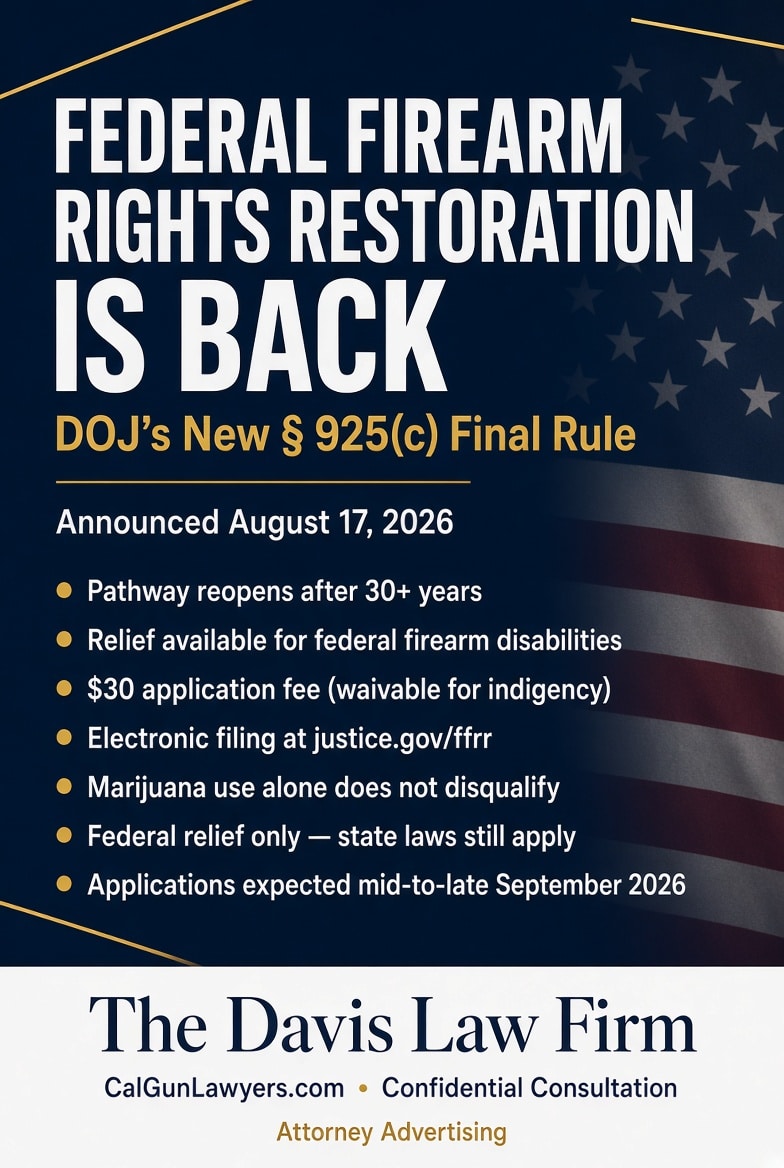
After more than three decades of dormancy, the federal pathway to restore firearm rights is officially reopening. On August 17, 2026, Attorney General Todd Blanche — in one of his first actions in office — publicly announced the finalized rule, AG Order No. 7109-2026, “Application for Relief from Disabilities Imposed by Federal Laws with Respect to the Acquisition, Receipt, Transfer, Shipment, Transportation, or Possession of Firearms,” which was signed on August 14, 2026 and has been transmitted to the Office of the Federal Register. The rule creates a brand-new regulatory framework, 28 CFR Part 107, that implements the relief mechanism Congress built into the Gun Control Act at 18 U.S.C. § 925(c) — a pathway the U.S. Pardon Attorney has described as opening the door for the roughly 30 million Americans currently under a federal firearm disability.
If you are prohibited from possessing a firearm under federal law, this rule defines, for the first time in a generation, exactly how you can apply to get those rights back — what you must submit, who is presumptively disqualified, and how decisions will be made.
Since 1968, § 925(c) has allowed a person prohibited from possessing firearms to apply to the Attorney General for relief from federal firearm disabilities. But beginning in 1992, Congress barred ATF — the agency then handling applications — from spending money to process them, effectively freezing the program. The Department of Justice has now moved the function out of ATF and into the Department itself, with initial intake handled by staff within the Office of the Pardon Attorney, and has issued binding criteria for granting or denying relief.
In plain terms, the rule does four things. First, it establishes the application: the required forms, documents, fingerprints, references, and sworn statements every applicant must submit. Second, it sets the standard of review: the Attorney General may grant relief only where satisfied that the applicant “will not be likely to act in a manner dangerous to public safety” and that relief “would not be contrary to the public interest.” Third, it creates a system of presumptive disqualifications — permanent, time-limited, and status-based — under which certain applications will be denied absent extraordinary circumstances. Fourth, it defines the scope of relief: a grant removes the federal disability applied for, but does not remove any independent state-law prohibition, and any grant of relief is published in the Federal Register.
Every individual applicant, regardless of prohibition category, must submit: a statement of every § 922(g) prohibition that applies; written consent for DOJ to obtain background, employment, medical, military, and criminal records; an electronic fingerprint scan or two FBI fingerprint cards; a criminal record check from every state where the applicant has lived or been arrested since age 18 (or the last 25 years, whichever is shorter); copies of any prior state expungement, set-aside, or rights-restoration applications and decisions; affidavits from three references — non-relatives who have known the applicant at least three years and are not themselves prohibited persons — attesting under penalty of perjury to the applicant’s law-abiding conduct, sobriety, mental stability, character, and safety; and the applicant’s own sworn affirmation covering the same ground, including that the applicant has committed no crime in the past five years and has not threatened violence or suicide in the past five years.
Beyond those universal requirements, the rule adds class-specific documentation:
Felony convictions (§ 922(g)(1)). The charging instrument, any plea agreement and factual basis, any presentence report, the judgment of conviction, and a certificate from the corrections, probation, or parole authority stating the date the full sentence — including supervision — was completed.
Mental health adjudications or commitments (§ 922(g)(4)). The order of adjudication or commitment, the underlying petition, medical records sufficient to characterize the diagnoses, any order showing discharge or restoration of competency or rights, and — critically — a current certification from a licensed mental health professional that the applicant no longer suffers from the condition, or that it has been successfully treated or is stably managed such that the applicant is unlikely to be a danger to self or others. Note: applicants in this class who are eligible for a state or federal relief-from-disability program must pursue that program first; failing to do so (or having been denied there) triggers a presumptive denial at the federal level.
Military convictions and dishonorable discharges (§ 922(g)(6)). The DD Form 214 (and any DD 214-1/215), and where applicable the Charge Sheet (DD Form 458), judgment of the court-martial, and certificate of completion of appellate review.
Renounced U.S. citizenship (§ 922(g)(7)). A copy of the formal renunciation of nationality plus a sworn supplemental statement explaining why citizenship was renounced.
Misdemeanor crimes of domestic violence (§ 922(g)(9)). The charging instrument, the underlying investigative reports, a statement of the victim’s relationship to the applicant, the judgment of conviction, a sentence-completion certificate, any record of the conviction being nullified or civil rights restored, and any police reports involving domestic violence from the original arrest to the present.
Certified copies are required, though digital copies of certified documents are permitted. If records are genuinely unavailable through no fault of the applicant (destroyed, purged, lost to time), the applicant may substitute a detailed sworn statement describing the facts, the disposition, and the efforts made to obtain the records. Foreign-language documents require certified English translations, and equivalent foreign records must be produced.
Absent extraordinary circumstances, DOJ will deny applications from three groups. Permanently disqualified: anyone convicted of a felony involving a death, rape or sexual abuse, human trafficking, kidnapping, domestic violence, burglary, robbery, extortion, carjacking, arson, violent racketeering, gang offenses, maiming, assault or battery, stalking, escape, terrorism, or witness tampering — or any felony in which the applicant brandished or discharged a firearm or used an explosive — including attempts, solicitation, conspiracy, and aiding and abetting. DOJ will look at the actual underlying conduct, not just the label of the offense.
Disqualified for a term of years: ten years for felony drug trafficking, threats of violence, explosives offenses, most federal firearms offenses, weapons on school property, and animal abuse; ten years for a misdemeanor crime of domestic violence, with the clock restarting if the applicant incurs a new disability or a qualifying arrest during that window; and five years for any other felony or for any assault, battery, stalking, or threatened-violence offense. The clock runs from the later of conviction or completion of any part of the sentence.
Status-based disqualifications: anyone currently awaiting sentencing, serving any part of a sentence, participating in pretrial diversion or a similar program, a fugitive, unlawfully present in the United States, subject to a qualifying protective order, a current unlawful user of or addicted to a controlled substance (marijuana excluded), or required to register as a sex offender based on a disqualifying offense.
Each presumption is rebuttable only by a showing of extraordinary circumstances, which the rule leaves to case-by-case determination — one of the areas where experienced counsel and a well-built record matter most.
The rule is effective, and DOJ will begin soliciting applications, 30 days after the rule is published in the Federal Register. As of the date of this article (August 17, 2026), the rule has been announced and transmitted to the Office of the Federal Register but has not yet been published — so the 30-day clock has not started, and no specific calendar date is fixed. DOJ confirmed in its announcement that the rule “will take effect thirty days after publication in the Federal Register.” Assuming publication in the coming days, applications are expected to open in mid-to-late September 2026. DOJ has directed the public to www.justice.gov/ffrr for eligibility information, application instructions, and access to the application process once it goes live. We are monitoring the Federal Register daily and will confirm the precise opening date the moment the rule publishes.
Prospective applicants should set realistic expectations. The Department estimates roughly 330,000 applications in the first year alone, and it has expressly declined to commit to any decision timeline, noting that processing times will vary with case complexity, record availability, application completeness, applicant responsiveness, cooperation from other government entities, and sheer volume — and that delays during the initial launch should be expected. There is no expedited track for any category of applicant, and no internal administrative appeal; the remedy for a denial is a petition for judicial review in federal district court.
The process itself will look like this: you assemble and file a complete electronic application with the $30 fee, fingerprints, certified records, reference affidavits, and sworn affirmations; DOJ conducts intake and notifies your local chief law enforcement officer; the Department investigates your full history under the public-safety and public-interest standard; and a decision issues. If your application is incomplete, you get one 30-day window to cure it before it is deemed abandoned. If relief is granted, notice is published in the Federal Register and your federal disability is lifted — though any state prohibition remains until addressed separately. If relief is denied, the grounds for the denial dictate whether and when you can reapply, which makes getting the application right the first time enormously consequential.
Because a weak or premature application can trigger a five-year — or effectively permanent — reapplication bar, we strongly recommend against filing without a full eligibility assessment. Here is how we help prospective clients position themselves now, before the portal opens:
If you have lost your firearm rights and want to know where you stand under the new rule, contact The Davis Law Firm today to schedule a confidential consultation. The application window opens soon — and the clients who are best positioned on day one will be the ones who started preparing before it did.
This article is attorney advertising and is provided for general informational purposes only. It is not legal advice and does not create an attorney-client relationship. The rule discussed is the unofficial version as transmitted to the Federal Register; the official text and effective dates will be established upon publication. Individual eligibility depends on the specific facts of each case.
Subscribe to get the latest posts sent to your email.