


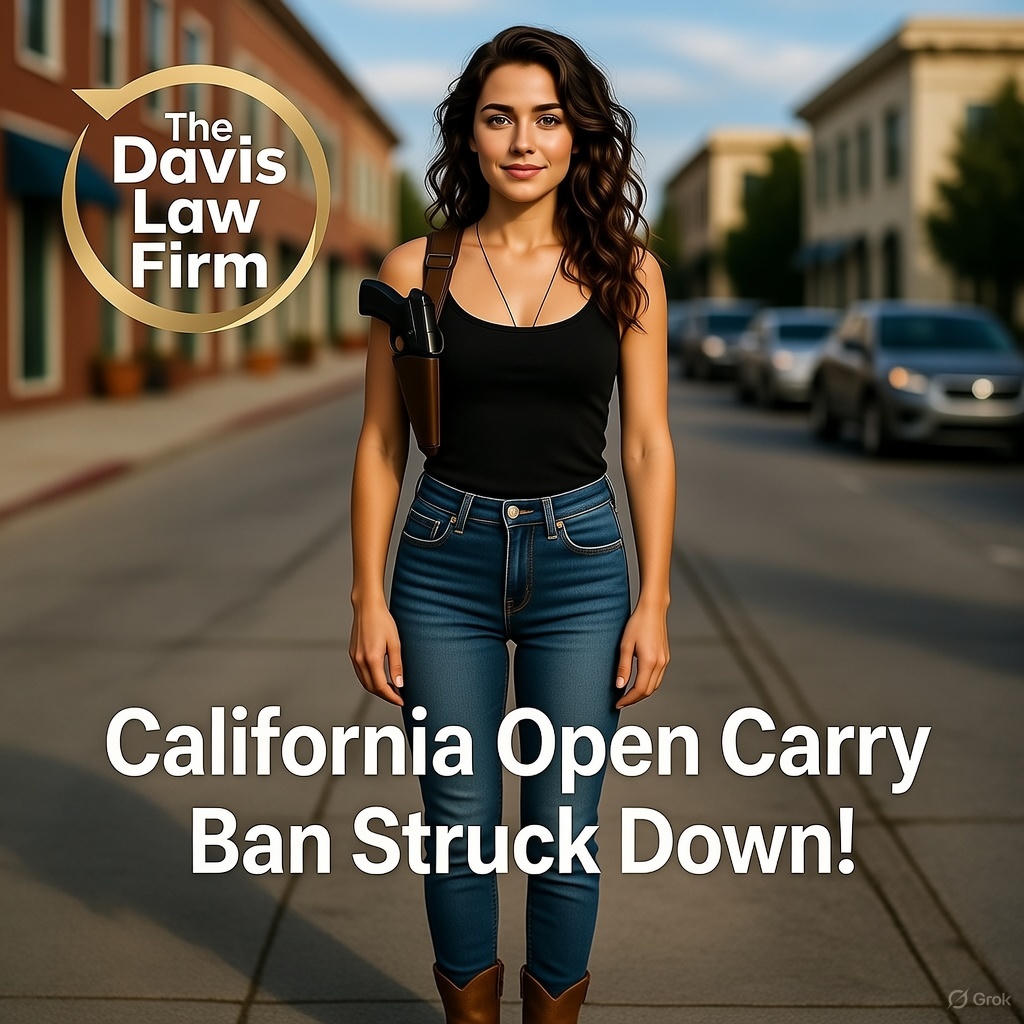
In a pivotal decision released today, the U.S. Court of Appeals for the Ninth Circuit has partially invalidated California’s stringent restrictions on the open carry of firearms, declaring the state’s ban on open carry in urban counties (>200,000 population) unconstitutional under the Second Amendment. The case, Baird v. Bonta (No. 24-565) (Opinion attached below), pits individual gun rights against state regulatory authority in the wake of the Supreme Court’s 2022 ruling in New York State Rifle & Pistol Ass’n v. Bruen. Authored by Judge Lawrence VanDyke, the opinion affirms that open carry is deeply rooted in American history and tradition, while a concurrence by Judge Kenneth K. Lee accuses California of employing “subterfuge” to undermine citizens’ rights in rural areas. Senior Judge N. Randy Smith dissented in part, arguing the ban aligns with historical precedents allowing states to favor one mode of carry over another.
This ruling, filed on January 2, 2026, could dramatically expand public carry options for millions of Californians, particularly in densely populated areas where open carry has been prohibited since 2012. However, it leaves intact the state’s licensing requirements for rural counties and does not address loaded carry or other firearm regulations. Legal experts predict swift appeals, potentially escalating to the Supreme Court, as gun rights groups celebrate and gun control advocates express concerns over public safety.
At the center of the case is Mark Baird, a law-abiding resident of rural Siskiyou County in Northern California. Baird, who owns firearms legally, filed his civil rights lawsuit in 2019, seeking to openly carry a handgun for self-defense without facing criminal penalties. Open carry, as defined under California law, involves carrying a firearm visibly—such as in a holster on one’s hip—distinct from concealed carry, where the weapon is hidden from view.
California’s framework for public carry is governed by several Penal Code sections. Key among them is § 26350, which outright bans open carry (even of unloaded firearms) in all counties with populations exceeding 200,000—a threshold that, based on the latest census data, encompasses about 95% of the state’s 39 million residents, including major urban centers like Los Angeles, San Francisco, and San Diego. In the remaining rural counties (fewer than 200,000 residents), open carry is nominally permitted but requires a county-specific license under §§ 26150 and 26155. These licenses mandate objective criteria, such as completing a firearms training course, passing a background check, and demonstrating a general need for self-defense.
Baird challenged these laws on both facial grounds—arguing they are unconstitutional in all circumstances—and as-applied grounds, claiming they violated his personal rights under the Second Amendment (as incorporated against the states via the Fourteenth Amendment). He contended that the urban ban and rural licensing scheme effectively nullify the right to bear arms openly, a practice he described as essential for self-defense.
The case also delved into California’s historical gun regulations, revealing a troubling legacy. From California’s statehood in 1850 until 1967, public carry—open or concealed—was entirely unregulated. The 1967 Mulford Act, named after Assemblyman Don Mulford, criminalized loaded open carry amid racial tensions. It was explicitly a response to the Black Panther Party’s armed patrols in African-American communities protesting police brutality. A catalyzing event was a 1967 protest at the state capitol where Panthers carried loaded firearms, prompting then-Governor Ronald Reagan to sign the bill. Unloaded open carry remained legal until 2012, when § 26350 extended the ban to urban areas. The opinion notes early proposed restrictions, like an 1856 concealed carry ban targeting “Mexicans,” were steeped in racial animus, underscoring how gun laws have sometimes been used to disenfranchise minorities.
Baird’s lawsuit originated in the U.S. District Court for the Eastern District of California (No. 2:19-cv-00617-KJM-AC), presided over by Chief Judge Kimberly J. Mueller. Baird initially requested a preliminary injunction to block enforcement of the open carry restrictions. The district court denied this in 2020 without fully evaluating his likelihood of success on the merits, focusing instead on other factors.
Baird appealed to the Ninth Circuit, which in 2023 vacated the denial and remanded the case. The appellate panel instructed the district court to apply the Supreme Court’s new framework from Bruen, which requires courts to assess gun laws based on the Second Amendment’s text and the nation’s historical tradition of firearm regulation, rather than interest-balancing tests.
On remand, rather than ruling on the injunction, Judge Mueller granted summary judgment in favor of Attorney General Rob Bonta in November 2023. She concluded that open carry is not protected by the Second Amendment and that California’s laws were consistent with history.
Baird appealed again, leading to today’s decision. The case was argued on June 24, 2025, in Seattle before Judges N. Randy Smith, Kenneth K. Lee, and Lawrence VanDyke. Amicus briefs were filed by gun rights organizations, including the Mountain States Legal Foundation, Gun Owners of America, and others, supporting Baird.
Judge VanDyke’s 98-page opinion systematically applies Bruen‘s two-step test.
The court first examined whether Baird’s conduct—openly carrying a handgun for self-defense—is presumptively protected by the Second Amendment’s plain text: “the right of the people to keep and bear Arms, shall not be infringed.” Drawing from District of Columbia v. Heller (2008) and Bruen, VanDyke concluded that “bear” encompasses public carry, and open carry is the historical default. The opinion cites evidence that open carry was the norm in early America, remaining legal in over 30 states today, including populous ones like Texas and Ohio. It rejects California’s argument that the Amendment only protects concealed carry, noting that open carry was “clearly protected at the time of the Founding and at the time of the adoption of the Fourteenth Amendment.”
Under Bruen, if conduct is covered by the text, the government must demonstrate the regulation is consistent with historical tradition. California failed this burden for the urban ban. The court found no Founding-era laws restricting peaceful open carry—only those targeting misuse, like “affrays” (public fights). Antebellum cases from states like Alabama, Louisiana, and Georgia affirmed open carry rights. Even post-Civil War, restrictions were rare and not “distinctly similar” to California’s blanket urban prohibition.
VanDyke highlighted modern trends: Texas reauthorized unlicensed open carry in 2021, Kansas in 2015, and Oklahoma in 2012. California’s 2012 ban, he wrote, joins a “tiny minority” of states and deviates from the national norm. The court reversed summary judgment on the urban ban (§ 26350), remanding for judgment in Baird’s favor on both facial and as-applied challenges.
For the rural licensing scheme, the court held Baird waived his as-applied challenge by not briefing it. His facial challenge failed, as Bruen endorses “shall-issue” regimes with objective criteria. On paper, California’s rural system qualifies, requiring only training and background checks, with self-defense as sufficient cause.
Judge Lee, joined by VanDyke, concurred fully but wrote separately to spotlight what he termed California’s “subterfuge” in thwarting open carry rights even in rural areas. While the state claims its rural licensing is “shall-issue”—mandatory issuance upon meeting criteria—Lee pointed to damning evidence: California admitted in litigation that it has no record of ever issuing a single open-carry license since the system’s inception.
Lee delved into potential reasons for this zero-issuance rate, suggesting deliberate obfuscation. For instance, the state’s Department of Justice website and application forms provide misleading or incomplete guidance on open-carry permits, often conflating them with concealed-carry processes or omitting key steps. Applicants in rural counties, like Baird’s Siskiyou, must apply to local sheriffs, but sheriffs’ offices reportedly direct inquiries back to state resources that lack specific open-carry instructions. Lee cited deposition testimony from state officials acknowledging confusion and a lack of dedicated open-carry application forms.
This “subterfuge,” Lee argued, effectively renders the rural scheme a de facto ban, denying Second Amendment rights through bureaucratic hurdles rather than overt prohibition. He warned that such tactics could invite future as-applied challenges, urging California to clarify and streamline the process. “The state cannot profess to allow a right while quietly ensuring no one can exercise it,” Lee wrote, comparing it to poll taxes or literacy tests historically used to suppress voting rights. This concurrence amplifies concerns about good-faith implementation, potentially influencing how lower courts handle similar claims.
Senior Judge Smith concurred on the rural licensing but dissented on the urban ban. He argued open carry is not covered by the Second Amendment’s plain text, as “bear” historically implied concealed or discreet carry in some contexts. Even if covered, Smith contended Bruen allows states to restrict one mode of public carry (open) if another (concealed) is available for self-defense. Since California permits shall-issue concealed carry statewide, the open carry ban is constitutional to promote public safety in urban environments.
Today’s ruling invalidates the urban open carry ban, potentially allowing unloaded open carry without a license in 95% of the state—provided other laws, like the loaded carry prohibition (§ 25850), are followed. It reinforces Bruen‘s history-focused test, scrutinizing modern restrictions without historical parallels. Gun rights advocates, including amicus filers like Gun Owners of America, view it as a major victory against “infringements.” Critics, including gun control groups, warn of increased urban tensions and accidental discharges.
The decision may inspire challenges in other states with urban-rural divides, like New York or Hawaii. It also spotlights racially tinged gun law histories, prompting calls for reform. However, rural residents remain bound by licensing, though Lee’s concurrence signals vulnerability to further suits.
The Ninth Circuit’s mandate will issue in 7-21 days, making the ruling binding unless stayed. California could seek en banc review or Supreme Court certiorari. If upheld, the district court must enter judgment for Baird, possibly issuing an injunction. Baird may recover attorney’s fees under 42 U.S.C. § 1988. Future litigation could clarify loaded carry or rural denials.
Judge Lawrence VanDyke, appointed by President Trump in 2019, is known for conservative rulings on guns, environment, and immigration. A Harvard Law graduate, he previously served as Nevada’s Solicitor General and in the DOJ. His confirmation was contentious, with the ABA rating him “not qualified” over temperament concerns, but supporters lauded his advocacy.
As this decision breaks new ground, here are answers to anticipated frequently asked questions based on the opinion and California’s firearm laws:
1. Does this mean I can open carry in California today? Not immediately. The ruling was filed today (January 2, 2026), and it becomes effective upon the Ninth Circuit’s mandate, typically in 7-21 days. Even then, California might request a stay pending appeal. Once effective, unloaded open carry without a license should be allowed in urban counties (>200,000 population), but loaded carry still requires a license under Penal Code § 25850. Always check with local law enforcement and comply with other restrictions (e.g., no carry in schools or government buildings).
2. When can I start openly carrying a firearm? Assuming no stay, after the mandate issues (likely mid-to-late January 2026). The ruling strikes down the ban on unloaded open carry in urban areas (>200,000 population), so eligible adults (law-abiding, non-prohibited persons) could begin then. However, in rural counties, a license is still required. Monitor updates from the California DOJ or courts for any delays.
3. Do I need a license to open carry now? For unloaded open carry in urban counties (>200,000 population): No, once the ruling takes effect. For loaded open carry anywhere: Yes, a license is still needed. In rural counties, all open carry requires a county-issued permit. The court upheld the facial validity of rural licensing, but noted potential issues with issuance.
4. What about loaded vs. unloaded open carry? The struck-down ban (§ 26350) targeted unloaded open carry in urban areas (>200,000 population). Loaded open carry remains prohibited without a license statewide (§ 25850). You can openly carry an unloaded firearm (e.g., in a holster) in urban areas (>200,000 population) post-mandate, but loading it could lead to charges unless licensed.
5. Does this apply to me if I live in a rural county? The urban ban (>200,000 population) doesn’t affect rural areas, and the court upheld the licensing requirement there. However, if you’ve been denied a license or face hurdles, the concurrence suggests grounds for an as-applied challenge due to the state’s lack of issuances.
6. Will California appeal, and what happens if they win? Likely yes—en banc or to the Supreme Court. A successful appeal could reinstate the ban. In the meantime, the ruling stands unless stayed.
7. Am I protected if I open carry based on this ruling? Exercise caution. Law enforcement may not immediately adjust, and other laws (e.g., brandishing prohibitions) apply. Consult an attorney or gun rights group for guidance.
8. How does this affect concealed carry? It doesn’t. Concealed carry remains available statewide via shall-issue licenses, which the court cited as an alternative mode of carry.
Subscribe to get the latest posts sent to your email.