


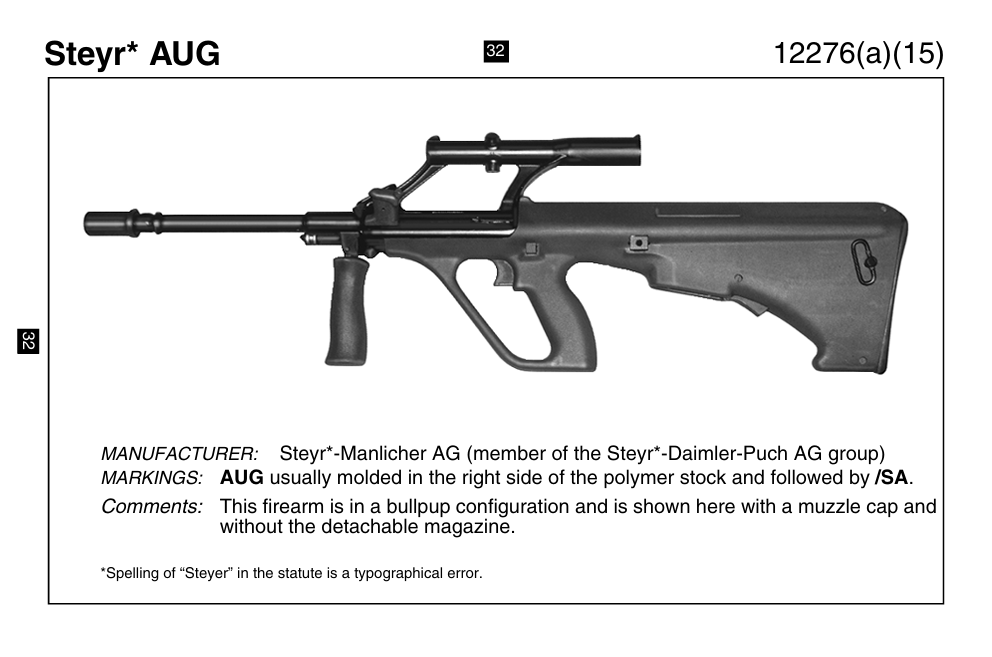
California’s “assault weapons” legislation, originating with the Roberti-Roos “Assault Weapons” Control Act of 1989 (AWCA), codified in Penal Code § 30510, employs a list-based approach to prohibit specific firearms by name and model. This article scrutinizes a longstanding typographical error in the statute, where “Steyr AUG” was misspelled as “Steyer AUG,” persisting for 35 years until corrected by Assembly Bill 3064 (AB 3064) in 2024. We argue that this error raised due process concerns by failing to provide fair notice to owners of genuine Steyr AUG rifles, as supported by Harrott v. County of Kings (2001) 25 Cal.4th 1138 and vagueness doctrine precedents like Kolender v. Lawson (1983) 461 U.S. 352. Additionally, the California Department of Justice (DOJ) improperly interpreted the statute in its identification guide, effectively regulating unlisted firearms. AB 3064’s correction, effective January 1, 2025, without a registration period, abruptly criminalized lawfully owned Steyr AUGs, potentially constituting a Fifth Amendment taking, as analyzed through cases such as Wright v. Beck (9th Cir. 2020) 981 F.3d 719 and Lucas v. South Carolina Coastal Council (1992) 505 U.S. 1003.
Enacted in response to rising concerns over mass shootings, the AWCA of 1989 banned designated “assault weapons” by explicitly listing them in Penal Code § 30510 (formerly § 12276), aiming to satisfy due process by giving clear notice of prohibited items. However, the statute’s listing of “Steyer AUG”—a misspelling of the actual “Steyr AUG,” a semiautomatic bullpup rifle manufactured by Steyr Arms—created ambiguity. This error, recognized by the DOJ as a “typographical error” in its 2001 “Assault Weapons” Identification Guide, endured from 1989 until AB 3064 amended § 30510 in 2024, effective January 1, 2025. During this 35-year period, owners of authentic Steyr AUGs may have reasonably believed their firearms were unregulated, as they did not match the statutory text.
This article examines the constitutional issues arising from this misspelling. It first addresses due process violations, drawing on Harrott v. County of Kings to emphasize the need for precise, centralized identification of regulated items. Second, it critiques the DOJ’s interpretive overreach. Third, it analyzes AB 3064’s correction, which lacked a registration window, leading to overnight felony exposure for lawful owners. Finally, it explores Takings Clause implications, arguing that the deprivation of property without compensation or grace period offends Fifth Amendment protections.
The AWCA, effective January 1, 1990, prohibited the possession, sale, and manufacture of listed “assault weapons,” with Penal Code § 30510 enumerating specific models to ensure definiteness. This specificity aligns with due process under the Fourteenth Amendment, which mandates that laws provide “fair notice” to allow individuals to avoid prohibited conduct, as articulated in Grayned v. City of Rockford (1972) 408 U.S. 104, 108-09. Vague or imprecise statutes risk arbitrary enforcement and violate this principle.
The “Steyer AUG” misspelling undermined this clarity, as no such firearm exists; the actual product is the “Steyr AUG.” In Harrott v. County of Kings (2001) 25 Cal.4th 1138, the California Supreme Court invalidated a trial court’s independent declaration that a firearm was an “assault weapon” under the AWCA, holding that such determinations must follow a centralized process involving the Attorney General to ensure uniformity and fair notice. The court emphasized that decentralized classifications could lead to confusion, depriving citizens of due process by making it difficult to know if their firearms are prohibited. Applying Harrott, the misspelling here similarly frustrates uniform identification, as owners of Steyr AUGs could not reasonably anticipate regulation based on a non-matching name.
Supporting vagueness doctrine cases bolster this analysis. In Kolender v. Lawson (1983) 461 U.S. 352, 357-58, the Supreme Court voided a statute for lacking explicit standards, stressing that laws must define offenses with sufficient definiteness to prevent arbitrary application. Likewise, United States v. Davis (2019) 139 S. Ct. 2319 invalidated an imprecise criminal provision, reinforcing the need for exactness in regulatory language. The U.S. Supreme Court’s decision in United States v. Davis (2019) 139 S. Ct. 2319 further illustrates the perils of imprecise statutory language in criminal regulations, directly analogous to the “Steyer AUG” misspelling. In Davis, the Court invalidated a residual clause defining “crime of violence” as unconstitutionally vague because it required speculative interpretations that deprived defendants of fair notice and invited arbitrary enforcement. Similarly, the AWCA’s erroneous listing of “Steyer AUG”—a non-existent firearm—creates comparable vagueness by failing to clearly identify the regulated Steyr AUG, potentially leading owners to unknowingly violate the law. This imprecision not only undermines due process but also highlights how even minor textual flaws in punitive statutes can render them unenforceable against the intended targets, as courts must apply criminal laws strictly and resolve ambiguities in favor of the accused. Although courts generally hold that minor typographical errors do not invalidate statutes if legislative intent is clear (e.g., United States v. Groh (2004) 540 U.S. 551, noting clerical errors in warrants), the “Steyer” error substantively misidentified the item, potentially leading to due process violations where affected parties lack fair notice.
For 35 years (1989-2024), the DOJ acknowledged the error in its “Assault Weapons” Identification Guide, labeling it a “typo” and regulating “Steyr AUG” despite the statutory “Steyer.” This administrative fiat exceeded authority, as agencies cannot rewrite statutes. The California DOJ’s adminstrative fiat extends beyond their attempt to change the statutory language of “Steyer” in the “Assault Weapon Identification Guide” to defining non-firearms as “Assault Weapons” by make and model. This is evidenced by its inclusion of the “Knights RAS (all)” in the Category 2 “assault weapons” list under the AR-15 series in the 2001 “Assault Weapons” Identification Guide. In reality, the Knights Armament RAS (Rail Adapter System) is not a firearm but an accessory—a modular rail system manufactured by Knight’s Armament Company for attaching optics and other components to rifles like the M4 or AR-15. Such overreach underscores the fallibility of administrative expansions of statutory bans, raising due process concerns by potentially subjecting owners of unlisted rifles equipped with this accessory to felony charges without clear legislative intent or fair notice. In Yamaha Corp. of America v. State Bd. of Equalization (1998) 19 Cal.4th 1, courts defer to interpretations but not when they contradict plain text. Similarly, Steyr AUG owners could argue their firearms were unregulated, as they were not statutorily listed, allowing lawful purchases and possession within California.
This status changed with AB 3064 (2024), which amended § 30510 to correct “Steyer” to “Steyr,” effective January 1, 2025. While minor, the deletion of an “e” from the statute instantly classified Steyr AUGs as “assault weapons,” subjecting owners to felony charges under Penal Code § 30600 (up to three years imprisonment).
Prior “assault weapons” laws provided registration periods for preexisting owners: the AWCA offered one year (1990), and SB 23 (1999) another. AB 3064 included no such provision, denying Steyr AUG owners an opportunity to maintain possession via registration. This omission violates procedural due process, as Mathews v. Eldridge (1976) 424 U.S. 319 requires balancing private interests (property rights) against government burdens, mandating notice and process before deprivation.
The abrupt ban also implicates the Takings Clause, requiring compensation for property taken for public use (U.S. Const., amend. V). By prohibiting possession without grandfathering or remuneration, AB 3064 denies all economically beneficial use of Steyr AUGs, constituting a regulatory taking per Lucas v. South Carolina Coastal Council (1992) 505 U.S. 1003, 1019, unless justified by background nuisance law. Firearms, as personal property protected post-District of Columbia v. Heller (2008) 554 U.S. 570, warrant Takings Clause scrutiny. In Wright v. Beck (9th Cir. 2020) 981 F.3d 719, the court permitted a takings claim against the LAPD for destroying seized firearms without process or compensation, rejecting police power exemptions for property destruction.
Current owners of Steyr AUG rifles in California face significant legal liabilities for continued possession following the effective date of AB 3064 on January 1, 2025, which corrected the longstanding “Steyer” misspelling and classified these firearms as “assault weapons” under Penal Code § 30510. Under Penal Code § 30605, unlawful possession of an “assault weapon” is a “wobbler” offense, prosecutable as either a misdemeanor—punishable by up to one year in county jail—or a felony, carrying penalties of 16 months, two years, or three years in state prison, along with fines up to $10,000, or both. Beyond criminal penalties, owners risk firearm confiscation, loss of gun rights, and civil liabilities if the weapon is involved in any incident. If you are in possession of a Steyr AUG or believe you may be affected by this law, it is crucial to seek immediate legal counsel to explore options such as voluntary surrender, relocation out of state, or potential defenses based on due process claims; contact us at [email protected] or at 866-545-GUNS for personalized advice.
The “Steyer” misspelling highlights how typographical errors can erode constitutional protections in regulatory schemes. Corrected after 35 years via AB 3064 without registration, it exemplifies due process lapses and potential takings violations. Legislators must incorporate safeguards like grace periods to uphold fair notice and property rights in firearm regulations.
Subscribe to get the latest posts sent to your email.