Archive for August, 2025

ATF Rescinds Controversial Classification of Franklin Armory Firearms: What It Means for Gun Owners

ATF Rescinds Controversial Classification of Franklin Armory Firearms: What It Means for Gun Owners

On August 29, 2025, the Bureau of Alcohol, Tobacco, Firearms and Explosives (ATF) issued an open letter that marks a pivotal moment for firearm enthusiasts, manufacturers, and Second Amendment advocates. The letter officially rescinds the ATF’s 2019 classification of Franklin Armory’s Reformation and Antithesis firearms, following a legal settlement with the Firearms Regulatory Accountability Coalition and Franklin Armory. This decision…read more →

Understanding California’s Firearm Prohibition Power of Attorney Form (BOF 110)

Understanding California’s Firearm Prohibition Power of Attorney Form (BOF 110)

In California, firearm ownership and possession are strictly regulated, especially for individuals who become prohibited from owning guns due to legal reasons. The California Department of Justice (DOJ) provides a specific form to help such individuals comply with the law: the General Notice of Firearm Prohibition and Power of Attorney for Firearms Relinquishment, Sale, or Transfer for Storage, commonly referred…read more →

The Legislative History of California’s Current 10-Day Waiting Period on the Delivery of Firearms

The Legislative History of California’s Current 10-Day Waiting Period on the Delivery of Firearms

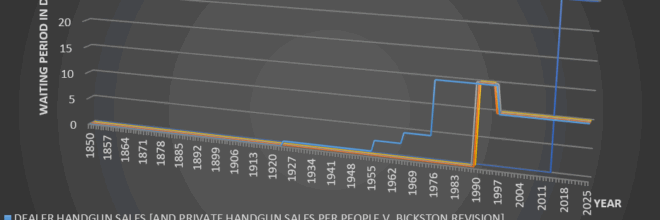
Currently, California has a 10-day waiting period on the delivery of firearms to the purchaser (Pen. Code §§ 26815(a) & 27540(a)). This applies to private party transfers through licensed dealers (Pen. Code § 27545), imposing the same delay. A review of the legislative history reveals that this 10-day waiting period is neither long-standing nor consistent in application. The legislature’s primary intent was to provide law enforcement time for background checks, driven by manual processes. The “cooling-off” intent to deter impulsive violence emerged only in the 1990s, falsely retroactively attributed via People v. Bickston (1979). With modern instant-check systems, these rationales are outdated.

Tenth Circuit Strikes Down New Mexico’s Firearm Waiting Period: Implications for Second Amendment Rights and Other States

Tenth Circuit Strikes Down New Mexico’s Firearm Waiting Period: Implications for Second Amendment Rights and Other States

In a landmark decision on August 19, 2025, the U.S. Court of Appeals for the Tenth Circuit ruled against New Mexico’s recently enacted seven-day waiting period for firearm purchases, finding it likely violates the Second Amendment. The case, Ortega v. Grisham, highlights ongoing tensions between state efforts to curb gun violence and individual rights under the U.S. Constitution. This article…read more →

Understanding FBI Criminal Records: Why Check Them and How to Obtain a Copy

Understanding FBI Criminal Records: Why Check Them and How to Obtain a Copy

What Are FBI Criminal Records? FBI criminal records, often referred to as Identity History Summary Checks or “rap sheets,” are comprehensive documents maintained by the FBI’s Criminal Justice Information Services (CJIS) Division. These records compile an individual’s criminal history, including arrests, convictions, and other interactions with law enforcement that result in fingerprint submissions to the FBI. The records are stored…read more →

Minnesota Gun Owners Caucus Challenges Binary Trigger Ban in Landmark Case

Minnesota Gun Owners Caucus Challenges Binary Trigger Ban in Landmark Case

Though not a California matter, we thought it was important to share a recent challenge to a firearm component restriction out of Minnesota, as it relates to the current California litigation addressing California’s expanded defintion of “assault weapon” through a similar challengable practice. In a significant legal battle, the Minnesota Gun Owners Caucus v. Walz case, filed on February 12,…read more →

The Ninth Circuit’s Second Amendment Resistance: From Silveira to Duncan’s Procedural Maneuvers

The Ninth Circuit’s Second Amendment Resistance: From Silveira to Duncan’s Procedural Maneuvers

The Ninth Circuit Court of Appeals has a well-documented history of resistance to the Second Amendment’s individual rights framework, a pattern that began with Silveira v. Lockyer (2002) and persists despite Supreme Court interventions in District of Columbia v. Heller (2008), McDonald v. City of Chicago (2010), and New York State Rifle & Pistol Association v. Bruen (2022). This resistance…read more →

Update on Rhode v. Bonta: California’s Ammo Background Check Case Faces Further Delays

Update on Rhode v. Bonta: California’s Ammo Background Check Case Faces Further Delays

California Seeks En Banc Review As of August 7, 2025, the fight over California’s ammunition background check laws just got longer. On July 24, 2025, a three-judge panel from the Ninth Circuit Court of Appeals ruled that the state’s requirement for background checks on every ammo purchase violates the Second Amendment. This affirmed a lower court’s decision to stop enforcing…read more →

Analysis of California Penal Code Section 468: Regulation of “Sniperscopes”

Introduction California Penal Code Section 468 regulates “sniperscopes,” devices that enhance the nighttime functionality of firearms, posing a significant risk in criminal activities due to their ability to facilitate precise targeting in low-light conditions. This statute criminalizes the unauthorized possession, sale, or transfer of “sniperscopes,” reflecting California’s broader efforts to control dangerous firearm accessories that could be used in crimes…read more →

Summary of ATF Requirements for Notification of Change of Control for a Federal Firearms License (FFL)

A “change of control” occurs when the licensed entity (e.g., a corporation or association) remains the same, but actual or legal control shifts—directly or indirectly—through mechanisms like stock ownership changes, operation of law, or other means.atf.gov This does not require an immediate new FFL application, but specific notification and follow-up steps are mandatory to maintain compliance under 27 CFR §…read more →

12