Why the DOJ’s 925(c) Firearms Relief Rule Is Taking Time — And Why That’s Normal

Why the DOJ’s 925(c) Firearms Relief Rule Is Taking Time — And Why That’s Normal

If you are a client, a potential client or you work with clients who lost federal firearm rights because of a past conviction, mental-health adjudication, or other disqualifier under 18 U.S.C. § 922(g), you’ve probably been watching the Department of Justice’s new rule on relief from disabilities (18 U.S.C. § 925(c)).

What the Rule Is About

For decades, § 925(c) has let the Attorney General restore federal firearm rights to people who can prove they are not a danger to public safety and that relief is in the public interest. But Congress blocked funding for the ATF (which used to handle these petitions), so the process was effectively dead.

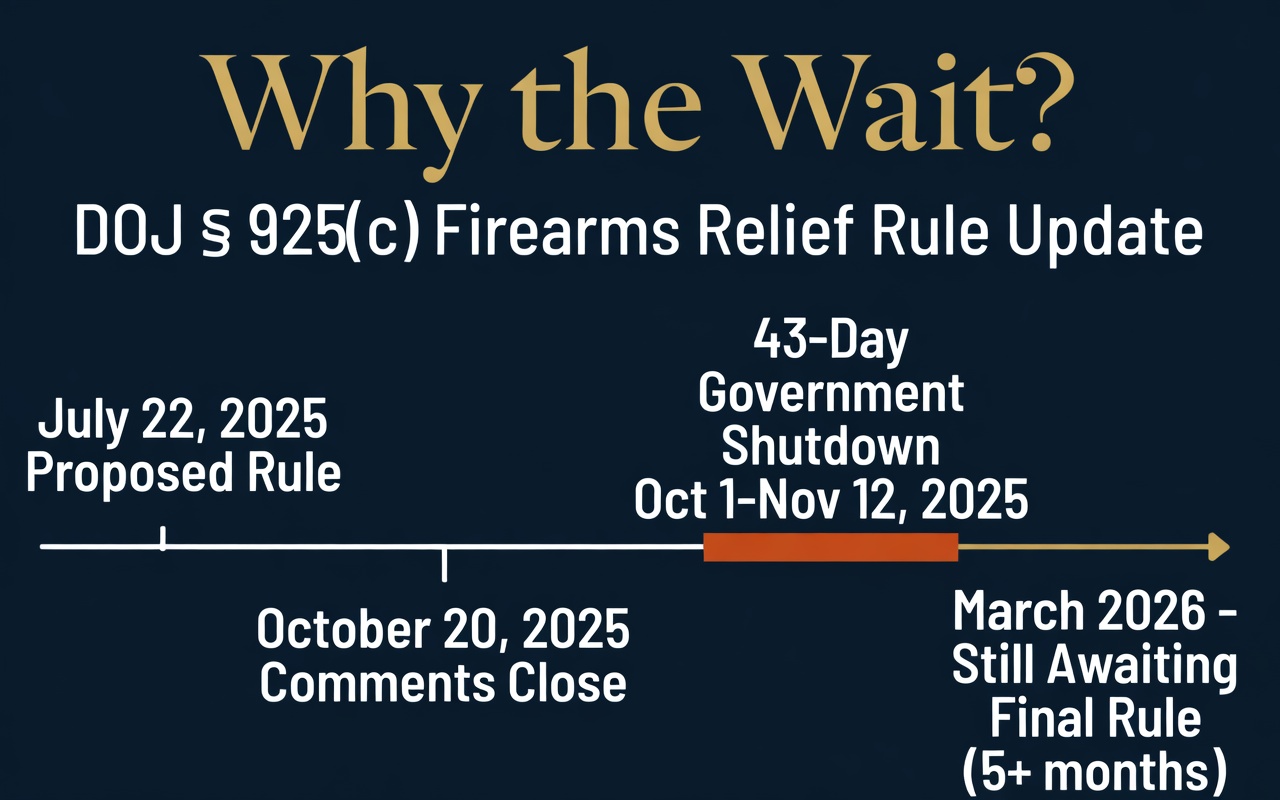
In early 2025 the Attorney General took the authority back. On July 22, 2025, DOJ published a proposed rule (Docket OAG-191, RIN 1105-AB78) that does three main things:

  • Sets clear criteria and “presumptions of ineligibility.”
    • Violent felons, sex offenders, stalkers, terrorists, etc. are presumptively ineligible forever unless there are truly extraordinary reasons. (Proposed 28 CFR § 107.1(a)(1)–(6), (10)–(13))
    • Other felons (drug distribution, domestic violence misdemeanors) face 10-year waiting periods; most other felonies face a 5-year waiting period after their full sentence (including probation/supervised release) ends. (Proposed § 107.1(a)(7)–(9))
    • Mental-health cases generally require recent professional certification or evidence that the person is not dangerous (addressed through the individualized dangerousness determination under the statutory standard). Citations: 90 FR 34394, 34396–34398, 34401–34403 (preamble discussion and proposed § 107.1(a)).
  • Creates a new application process run by the Office of the Pardon Attorney (not ATF).
    • Required documents, reference letters, fee (with waiver for indigency), and a self-certification under penalty of perjury. Citations: Proposed 28 CFR § 107.2–107.4 (application procedures); fee provisions at proposed § 107.5; 90 FR 34394, 34404–34405 (Pardon Attorney handling).
  • Prepares for a high-volume program.
    • DOJ estimates up to a million applications in the first year, so they built in fees to make the process self-sustaining (initial interim fee of $20 per application, waivable for indigency, with periodic review). Citations: 90 FR 34394, 34405–34406 (Regulatory Impact Analysis and fee discussion); proposed § 107.5.

Public comments closed October 20, 2025. Once the final rule is published, an online application portal will launch.

The Delay So Far

We are now five months past the comment deadline (as of late March 2026). No final rule has appeared yet in the Federal Register, and the Pardon Attorney’s website still says the application form is “coming soon” after the rule is finalized.

The Government Shutdown Factor

Right after comments closed, the federal government shut down for 43 days — from October 1 to November 12, 2025. That was the longest shutdown in U.S. history. During a shutdown, agencies cannot work on new or pending rules, OIRA (the White House review office) stops most reviews, and the Federal Register cannot publish final actions. This rulemaking was frozen for more than a month at the exact moment agencies normally start sifting through thousands of comments and drafting the final version.

How Long Is “Normal” After Comments Close?

There is no official average or median time the government publishes for the period between the end of public comments and the final rule. The Administrative Procedure Act does not set any deadline.

What we do know from studies and real-world data:

  • After comments close, agencies must read every submission, decide which changes to make, draft the final rule and a long preamble that answers “significant” comments, get internal approvals, and — for important rules — go through White House review (OIRA usually aims for 90 days but often takes less or more).
  • Simple, low-stakes rules can finish in 2–4 months.
  • Complex or controversial ones commonly take 6–18 months (sometimes longer).
  • Overall, the full trip from proposed rule to final rule often runs 16–20 months on average. Subtract the usual 60- or 90-day comment period and you’re left with many months of post-comment work.
  • Speculation, however, is that this rule is set to launch “SOON,” which is great news for those waiting to finally have their rights fully restored.

Is Five Months Unusual?

No — especially for this rule.

This is not a simple housekeeping change. It involves:

  • Second Amendment rights
  • Public-safety judgments
  • Brand-new procedures
  • An expected flood of applications
  • Political sensitivity

Add in the 43-day shutdown that hit at the worst possible time, and five months is squarely in the normal range. Many observers (including some who track the docket closely) expected the final rule in March or April 2026. We’re right around that window.

Bottom Line for Practitioners

The delay is annoying but routine. This rulemaking sits on the longer side of the usual timeline because it is complex and high-impact — not because anything has gone wrong.

Keep an eye on:

  • regulations.gov (search OAG-191)
  • justice.gov/pardon/ffrr (the Pardon Attorney page updates when the application launches)

Once the final rule drops, the online portal should follow quickly. Clients who meet the new criteria will finally have a clear, modern path to ask the federal government to restore their rights.

If you have clients who want to be ready the day the portal opens, let me know — we can start gathering the records and reference letters now so the application can be filed the moment it becomes available. The wait has been long, but the finish line is in sight.


Discover more from THE DAVIS LAW FIRM | (866) 545-GUNS

Subscribe to get the latest posts sent to your email.