


By Jason Davis March 25, 2026
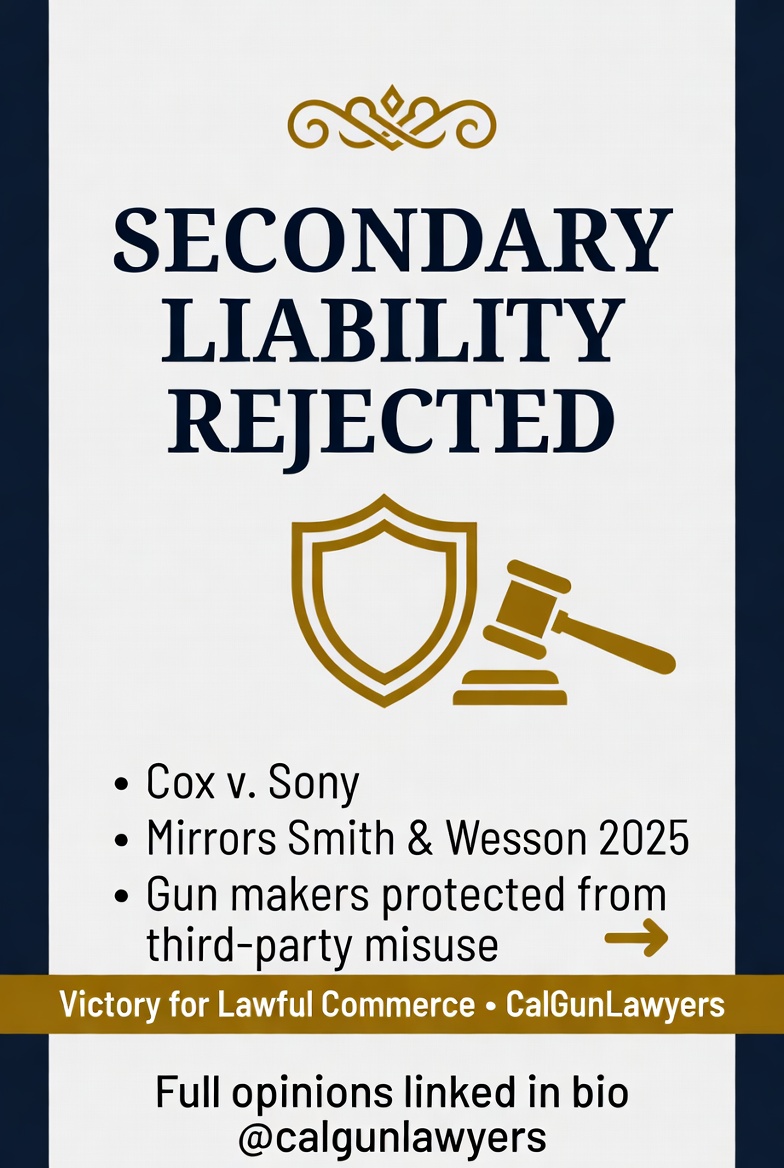
In a landmark ruling issued today, the U.S. Supreme Court in Cox Communications, Inc. v. Sony Music Entertainment (No. 24–171) slammed the door on expansive theories of secondary copyright liability for internet service providers (ISPs). The unanimous opinion, authored by Justice Thomas, holds that an ISP like Cox is not contributorily liable for its subscribers’ copyright infringement merely because it continued providing internet service after receiving notices of infringement. Liability requires proof of intent—either affirmative inducement of infringement or providing a service specifically tailored to it. Mere knowledge that some users will infringe, coupled with insufficient preventive action, is not enough.
Read the full Supreme Court opinion here: https://www.supremecourt.gov/opinions/25pdf/24-171_bq7d.pdf
This decision is not just a copyright case. It is a powerful reaffirmation of limits on “secondary” or “vicarious” liability that directly bolsters the firearms industry’s protections under the Protection of Lawful Commerce in Arms Act (PLCAA). Just as ISPs cannot be held liable for the unlawful acts of their users simply by providing a general-purpose service, gun manufacturers and sellers cannot be held liable for the criminal misuse of their products by third parties absent clear, active participation.
The Court traced the doctrine back to its foundational precedents—Sony Corp. of America v. Universal City Studios, Inc. (the Betamax case) and Metro-Goldwyn-Mayer Studios Inc. v. Grokster, Ltd. Contributory liability exists only where the provider (1) actively induces infringement or (2) supplies a service “not capable of ‘substantial’ or ‘commercially significant’ noninfringing uses.” Internet service, the Court emphasized, is “capable of substantial noninfringing uses” and is not “tailored to infringement.” Cox’s contractual prohibitions on infringement, warnings, and account terminations further undercut any claim of inducement.
The Fourth Circuit’s broader theory—that simply supplying a product with knowledge of its misuse suffices for liability—was squarely rejected as an impermissible expansion beyond the Copyright Act and the Court’s precedents. As the opinion states: “Mere knowledge that a service will be used to infringe is insufficient to establish the required intent to infringe.”
This reasoning mirrors last year’s unanimous decision in Smith & Wesson Brands, Inc. v. Estados Unidos Mexicanos (No. 23–1141, June 5, 2025). There, the Government of Mexico sued American gun manufacturers, alleging they aided and abetted illegal sales by retail dealers that funneled firearms to Mexican cartels. Mexico’s theory rested on three pillars: (1) continuing to supply “known rogue dealers,” (2) failing to impose stricter controls on distribution networks, and (3) making design and marketing decisions (e.g., “military-style” weapons or Spanish-language branding) that allegedly appealed to criminals.
Read the full Supreme Court opinion here: https://www.supremecourt.gov/opinions/24pdf/23-1141_lkgn.pdf
Justice Kagan’s opinion for the Court rejected every claim. Drawing on aiding-and-abetting principles from Direct Sales Co. v. United States (active, knowing participation) and Twitter, Inc. v. Taamneh (passive provision of a general service is not enough), the Court held that PLCAA’s predicate exception requires more than knowledge or nonfeasance. Routine sales to the open market—even with awareness that a small fraction will be misused—do not constitute aiding and abetting. “Omissions” and “inactions” in an already heavily regulated industry rarely support liability. Mexico’s suit was barred.
Both Cox and Smith & Wesson stand for the same core principle: Providers of lawful, multi-use products or services (internet access or firearms) are not the insurers of third-party criminal conduct.
Today’s Cox decision reinforces that congressional intent and the Court’s consistent jurisprudence limiting secondary liability.
Practical Impact:
Despite PLCAA’s clear text and purpose, several states have aggressively tried to expand the scope of firearms industry liability for third-party misconduct:
Today’s Cox ruling sends a clear message to state legislatures and lower courts: The Supreme Court is not inclined to expand secondary liability doctrines beyond their narrow historical bounds. Any state law or theory that effectively imposes liability on manufacturers for the mere provision of a lawful product—knowing some misuse will occur—faces an uphill battle.
The Supreme Court’s decision today in Cox v. Sony is a timely and powerful reinforcement of the rule of law in the face of creative attempts to circumvent statutory protections. For the firearms industry, it means continued stability and predictability: You may sell lawful products to lawful buyers without becoming the guarantor of every criminal who misuses them downstream.
At The Davis Law Firm, we will continue to monitor how lower courts apply Cox and Smith & Wesson to ongoing state-level challenges. The message from the highest Court is unmistakable: Secondary liability has limits.
Subscribe to get the latest posts sent to your email.